[First Biden removes the "terrorist" designation from the Colombian FARC terrorist group, clearing the way to openly embrace the group for some future American-sponsored terror campaign, much like the Obama/Biden creation of ISIS in Iraq and Syria (What Is The Truth About ISIS?). Qatar and Saudi Arabia built ISIS for Obama from the remains of Al-Qaeda in Iraq, in order to create a terrorist jihadi army, for the purpose of overthrowing Bashar Assad. ISIS was created to fight the wars started by Obama, Biden and Hillary inside Syria and Libya, serving as another CIA-created terrorist Islamist army, just like their Al-Qaeda predecessors.
Biden then designates the Colombian narco-state as a major non-NATO ally, even though it is home to hordes of "rehabilitated" FARC terrorists, in addition to all the Colombian cocaine cartel/mafias, not to mention all of those former American-trained military "death squads". He chooses the Colombian mercenaries/terrorists for the mission in Ukraine because these same killers have been killing for Western interests all over the globe for the past decade. Russia understands that the Colombian terrorists are the NEW ISIS.]
"In politics, the only true thing is what is not seen", José Martí.
1. The geopolitical consequences of the NATO-Russia confrontation impact Our America. The implications of the military conflict in Europe will be capital for the continent. This will increase the struggle of China, Russia and the United States for political influence and markets in America. Latin America and the Caribbean will be a key territory in the global dispute, a fundamental geo-strategic space.
2. Venezuela, Cuba and Nicaragua constitute important States for the current geopolitical confrontation between the great powers of the world. Additionally, history shows that the Latin American and Caribbean region is considered by the world's elites as a reservoir of raw materials. The foreign policy of imperialism, and particularly of the United States, confirms such an assertion. The armed confrontation in Europe, the consequences derived from the imposition of unilateral coercive measures against the Russian Federation, the international prices of hydrocarbons, the European energy dependency and the global problem of supply chains, place the United States and the European Union in a true energy emergency with serious economic consequences.
3. The "Provisional National Security Strategic Guide" approved by Biden defines Venezuela as a relevant State for US Military Doctrine. Venezuela's energy potential, among other things, places the country in the order of priorities that the US has in the region. Consequently, after the conflict between NATO and Russia, Venezuela will be the center of gravity of Washington's military planning. The official public agenda of the Biden-Duque meeting contains as topics to be discussed, among others, the "promotion of democracy and security." Hidden under this diplomatic euphemism is the approach to the Pentagon's military design for the region, the regional efforts against the Russian-Chinese alliance, and especially the new roadmap to end the Bolivarian Revolution. In that geo-strategic design,
4. It should be noted that Colombia joined NATO in 2018. The Armed Forces. Colombian companies have already adopted the NATO Doctrine, standardized their procedures and pursue interoperability through a "capability and training portfolio" provided by the Organization. The possible scenario assessed by the Pentagon consists of using Colombia to attack Venezuela, an issue that would allow it to take advantage of its status as a global partner of NATO, to invoke Article 5 of the Washington Treaty. The Principle of Collective Security contained in this article obliges NATO Member States to carry out military operations in the face of any attack on a State of the Organization. Consequently, a possible inter-state armed confrontation between Colombia and Venezuela would attempt to cover up US aggression. and NATO against Venezuela. This would mean a change in military tactics that could consist, instead of resorting exclusively to outsourcing the war through paramilitaries and mercenaries as has been happening in Apure, generating a casus belli with the Colombian State that allows NATO to carry out military operations against Venezuela. . In this scenario, Colombia would carry out the aggression, the border states governed by the opposition would be the first territories to join the plan, and NATO would serve to stop the military support of the allied powers of Venezuela. generate a casus belli with the Colombian State that allows NATO to carry out military operations against Venezuela. In this scenario, Colombia would carry out the aggression, the border states governed by the opposition would be the first territories to join the plan, and NATO would serve to stop the military support of the allied powers of Venezuela. generate a casus belli with the Colombian State that allows NATO to carry out military operations against Venezuela. In this scenario, Colombia would carry out the aggression, the border states governed by the opposition would be the first territories to join the plan, and NATO would serve to stop the military support of the allied powers of Venezuela.
5. Preparations for War? In keeping with NATO guidelines, the Damascus Doctrine, officially assumed since 2016, intends to prepare Colombia for a regular war. This supposes a hypothesis of armed conflict that places Venezuela as its main enemy. Indeed, Colombia is already organizing its Armed Forces. in a versatile way, it prepares them for multiple missions, it organizes Task Forces according to the peculiarity of military challenges, it structures its Joint Commands and equips them with new armored units as well as it seeks to obtain state-of-the-art combat aircraft to achieve supremacy. air, among other things. Joint military exercises, close military cooperation with the Pentagon, the US military bases around Venezuela and the deployment of its Security Assistance Brigade in New Granadan territory are part of the indications of the scenario that has been taking shape. Biden has already extended Executive Order 13962 of March 2015 where they describe Venezuela as a threat to their national security. This means that against Venezuela all options are on the table.
[Biden has revealed the next phase in his military moves against Russia, without having to risk open war w/Russian forces over Polish planes. By designating narco-state Colombia as a non-NATO US ally in the Ukraine affair, he is showing his hand. Colombian mercenary/terrorists have been a mainstay in the American attempt to overthrow Syria, as well as providing a terrorist army to Blackwater fame Eric Prince, which he fights for the king of UAE. Do not forget that 2 shady Americans recently hired a squad of Colombian terrorist/mercenaries to capture or kill the Pres. of Haiti...surely Putin will understand that Colombian fighter in Ukraine are American sent terrorists.]
By DARLENE SUPERVILLE - Associated Press By DARLENE SUPERVILLE - Associated Press
WASHINGTON (AP) — President Joe Biden said Thursday that he intends to designate Colombia as a major non-NATO ally, a step that will provide the Latin American nation with benefits in the areas of defense, trade and security cooperation.
Biden made the announcement as he hosted Colombian President Ivan Duque at the White House for the first time. The visit follows weekend talks between Biden administration officials and the leftist government of Nicolás Maduro in neighboring Venezuela, which has a tense relationship with both the U.S. and Colombia.
Avoiding a potentially awkward moment, neither Biden nor Duque raised the U.S.-Venezuela meeting in their public remarks. Colombia is a close U.S. ally, and Duque leads opposition to Maduro in the region,
Biden said he intends to bring Colombia into the NATO fold.
“That's exactly what you are, a major, major non-NATO ally, and this is a recognition of the unique and close relationship between our countries," he told Duque, who sat directly across from the president at a large table in the Cabinet Room, each leader joined by a small group of advisers.
"Colombia is the lynchpin, in my view, to the whole hemisphere,“ Biden said.
Duque said Biden’s announcement recognized “values and the principles” shared by both Western Hemisphere countries.
Back home, Duque has been criticized for not sitting down earlier with the U.S. president, his strategic partner. The two did meet briefly late last year at a gathering of world leaders for a climate summit in Glasgow, Scotland.
Duque's visit to the White House came amid Russia's invasion of Ukraine and approaching presidential elections in Colombia that will decide his successor.
When both presidents mentioned Venezuela, it was in the context of the assistance Colombia has provided nearly 2 million Venezuelan refugees who have crossed the border to flee poor economic and living conditions back home.
Duque has led regional opposition to Venezuela's Maduro, whom he describes as a “dictator" — a characterization he repeated under questioning by Colombian journalists after his meeting with Biden. Duque recognizes opposition leader Juan Guaidó as Venezuela’s interim president.
Colombia’s government has questioned the military assistance Russia has provided to Venezuela and has expressed fears of possible “foreign interference” in Colombia, which shares a vast border with Venezuela, without providing evidence.
Duque has not spoken publicly about the U.S.-Venezuela meeting, and continued to hold his tongue Thursday following the White House visit.
“On the issues and details having to do with the visit (to Venezuela), I think U.S. authorities have to answer about that,” he told the Colombian journalists. “Our position with respect to the regime of Nicolás Maduro has not changed at all.”
Colombian Vice President and Foreign Minister Marta Lucía Ramírez has said the meeting “took her by surprise.”
Venezuela recently announced a military deployment on the border to combat what it said are Colombian armed groups.
Both Biden and Duque denounced the Russian invasion of Ukraine, with Biden saying it was not just a threat to Ukraine but to “peace and stability” everywhere. He commended Duque for the strong stance he took against the invasion, including Colombia's vote in the U.N. General Assembly to condemn Russia's actions.
Duque has spoken out against Russia and pledged support for the international humanitarian response and the “corresponding sanctions.”
The war, which has entered its third week, is a “very horrifying moment for the world” that must be condemned “with a very strong sentiment," Duque said.
“Nothing justifies the bloodbath that we have been seeing continuously over the news in the last week,” he emphasized.
According to the State Department, U.S. law allows the designation of “major non-NATO ally” status for friendly countries, providing them with certain benefits in the areas of defense, trade and security cooperation. It's a symbol of close ties.
However, such countries are not entitled to the same security guarantees as full-fledged members of the NATO alliance. NATO member countries agree to defend each other if one comes under attack, but that protection does not extend to a major non-NATO ally.
Duque's visit comes shortly before a possible change in government in Colombia. It will hold presidential elections on May 29 and leftist candidate and Duque rival Gustavo Petro leads in the polls. Presidents in Colombia are limited to one, four-year term.
Petro has said he has other priorities and Colombia should not interfere in the invasion of Ukraine but focus on resolving internal problems with illegal armed groups.
Associated Press writers Astrid Suarez in Bogotá, Colombia, and Josh Boak in Washington contributed to this report.
Israel is having problems trying to profit from the Mediterranean gas field that it has been trying to steal from some of its neighbors. Drilling has been stopped since May 3, 2012 (SEE: Leviathan Oil Well Drilling Postponed) by Noble Energy’s “Homer Ferrington” rig, which had been working in the Leviathan gas field. Drilling stopped because of the unexpected high gas pressures encountered at the greatest depths.
Development of high-pressure gas, or “sour gas” (high sulfur content plus high pressure) requires deeper wells (new deep-drilling rig has been held-up in S. Korea until late next year) and extra facilities for reducing the pressure and lowering the sulfur content of the gas, in addition to the missing infrastructure that will be needed to be built for moving the gas from the Mediterranean to Israel, or to LP gas facilities, for shipping the product elsewhere.
In addition to the drilling problems, there have also been legal hang-ups (court challenge to monopoly ownership of Leviathan), as well as financing difficulties in acquiring partners. The major oil companies are afraid to invest in Israel, for fear of pissing-off the Arabs. Even companies like Dutch giant Shell will only consider investing in gas and oil exploration through third party partners, like Woodside Petroleum (Shell holds 23% of Woodside stock), which is allegedly a conglomerate composed of Chinese, Texas and Australian interests, in order to have deniability about any investment which might develop.
According to this interview in MoneyWeek, with Duke Energy CEO Jim Rogers, he claimed in 2006 that he “owned Woodside Petroleum,” The Woodside Energy company is currently at the center of an international spy scandal after having just acquired drilling rights off East Timor. That acquisition is at the center of an international stink storm that is now being generated by govt. leakers. A cloud of suspicion hangs over the drilling contract which may have relied upon insider information, obtained through espionage conducted by Australian spy agency ASIS, Australian Secret Intelligence Service (SEE: Australia’s Timor Spying Scandal. More Whistleblowers Emerge).
Here we have a very clear example of a national spy agency serving the interests of the corporations, confirming the evidence that Steve Kangas died for to bring it to the Internet. Steve died of a gunshot wound to the head in the home offices of conservative leader Richard Mellon Scaife. Mr. Scaife was Kangas’ favorite research subject (SEE: The Origins of the Overclass). His focus was upon exposing the nexus between the CIA and the rich and powerful and the corporations which they owned.
Are NSA spies acting as mentors to other intelligence agencies, manipulating them to align their interests with theirs, to facilitate their search for insider information for the big oil companies and corporations?
[From partners in the original war on terrorism, to the enemies that we appear to be today, what went wrong with the US/Russian era of cooperation? We went our separate ways in 2003, when Bush began his vendetta against Saddam Hussain and "Seven countries", former client states of the Soviet Union in the Middle East. Next, came the first anti-Russian "color revolution" in Ukraine in 2004, followed by a 2nd color revolution in 2014-15...all elements of an economic war against the Russian oil/gas industry (Gazprom), intended to bankrupt Russia by surgically removing key state Ukraine from that supply system, thereby destroying the heart of the Russian economy. "Independent Ukraine" has always been a pauper state, dependent on the generosity of Russia to furnish the base energy needs of its own people, choosing instead, to act as an nonpaying parasite on the Russian suppliers, as the price for allowing Russia to transit gas through Ukraine to the rest of Europe, or else to shut-down. When Russia chose to pipe its energy around Ukraine in new pipelines, the US waged further economic warfare against every project, promising Europe non-existent American LP Gas to replace the missing fuel. With the American-induced cancellation of both Northstream and Turkstream projects, Russia (Gazprom) had to retrench in Ukraine to continue to service Europe. Further U.S. attempts to strangulate the Russian economy and to isolate Putin run great risk of bringing about world war.]
As the battle of wills and might between Russia and the west over the fate of Ukraine unfolds, there is one key fact to bear in mind: Vladimir Putin has never lost a war. During past conflicts in Chechnya, Georgia, Syria and Crimea over his two decades in power, Putin succeeded by giving his armed forces clear, achievable military objectives that would allow him to declare victory, credibly, in the eyes of the Russian people and a wary, watching world. His latest initiative in Ukraine is unlikely to be any different.
Despite months of military build-up along Ukraine's borders and repeated warnings from the Biden administration that an incursion could happen at any time, the February 24 pre-dawn bombing campaign that kicked off Europe's first land war in decades seemed to come as a surprise to many Ukrainians. In major cities across a country the size of the state of Texas, stunned citizens, lulled into complacency by their president's repeated reassurances that Russia would not invade, watched and listened to the sound of thunderous explosions targeting Ukrainian military bases, airports and command and control centers. Within 24 hours, the conflict spread rapidly, with Russian tanks and troops moving swiftly toward Kyiv, the capital, and fighting around Chernobyl, the site of the disastrous 1986 nuclear reactor meltdown. Shock and awe, Russian style.
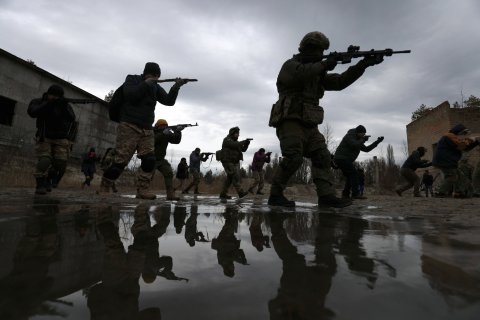
Despite repeated warnings that an invasion was imminent, many Ukrainians were shocked by the arrival of Russian troops. Here, members of Ukraine's Territorial Defense Forces participate in a drill days before the bombings began. Ethan Swope/Bloomberg/Getty
In an instant, Russian President Putin's invasion of Ukraine destroyed the post Cold War security order in Europe—one centered, to Russia's fury, by an often-expanding NATO alliance. Analysts expect that, once Kyiv falls, the military aggression will give way to a political settlement that puts a Russia-friendly government in place. By February 25, Ukrainian President Volodymyr Zelensky was considering an invitation from Moscow to hold "neutrality" talks in neighboring Belarus. If those talks happen, Putin will then be able to pull back troops and end the conflict—while having dealt the West a humiliating blow.
And that, military and Russia experts agree, may be the real point.
Ukraine, of course, is not a NATO member; the possibility that it might join the Alliance some day, as other countries that were once part of the old Soviet bloc have done, is a key issue in the current conflict. Putin's actions, a brazen defiance in the face of repeated warnings and threats of sanctions from U.S. President Joe Biden and western allies, now make it a certainty, if it wasn't before, that membership will never happen. Putin's aggression will also serve as a stark warning to countries formerly part of the Soviet Union of the possible repercussions of getting too cozy with the West.
The post Soviet status quo in Eastern Europe was one "that [Putin] never accepted," says Fyodor Lukyanov, editor in chief of Russia in Global Affairs, a Moscow-based foreign policy journal. "It ate at him. He believes Russia was treated [by the West] as a second class citizen after the Soviet Union fell."
Now, western diplomats and intelligence officials believe, Putin seeks to decapitate the western-leaning leadership in Kyiv headed by Zelensky and replace it with a government that will be loyal to "the new Tsar," as former Estonian President Toomas Ilves calls Putin. That could happen, U.S. intelligence officials tell Newsweek, within days. Putin does not want, nor does he need, to occupy the entire country to accomplish his greater goals, intelligence analysts and officials say. As Ilves puts it, "He wants a puppet state like Belarus," another former Soviet province just north of Ukraine, and from which troops poured into Ukraine as the Russian bombing ramped up. With a new reality on the ground in Eastern Europe, Ilves continues, "Putin then wants to rewrite the security rules of the road between him and NATO."
Ukraine itself appears to share at least part of that view. A statement from Mykhailo Podolyak, an adviser to Ukraine's presidential chief of staff, and shared with Newsweek by Ukraine's embassy in Washington, outlined what Kyiv suspected were Moscow's goals. "The Office of the President of Ukraine believes the Russian federation has two tactical goals—to seize territories and attack the legitimate political leadership of Ukraine in order to spread chaos and [to] install a marionette government that would sign a peace deal on bilateral relations with Russia," Podolyak said.
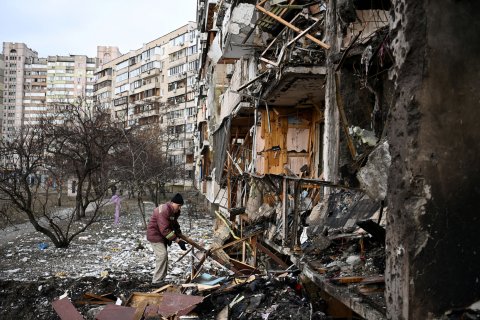
A man clears debris at a damaged residential building at Koshytsa Street, a suburb of the Ukrainian capital Kyiv, where a military shell allegedly hit, on February 25, 2022.Daniel Leal/AFP/Getty
A United States that thought it was pivoting to Asia, and focusing on China—a country that is its preeminent rival going forward—has now been dragged back to Eastern Europe, where for centuries so much blood has been spilled. Putin now has the world's full, undivided attention, in the same way that every Secretary General in the Soviet era did. In chilling televised remarks after the invasion had begun, Putin said, "whoever tries to interfere [in Ukraine] should know that Russia's response will be immediate, and will lead to such consequences that you have never experienced in your history."
Russia is now back in the limelight, a nation that is demonstrating, with a display of military might, that it remains a Great Power. Which is precisely where Putin wants his nation to be. He believes Russia should at all times command respect from the rest of the world, "and when it doesn't command respect, it should command fear," as Lukyanov of Russia in Global Affairs puts it.
Mission accomplished. As Rose Gottemoeller, former deputy secretary general of NATO and a long time Russia watcher characterized it recently on the CBS podcast Intelligence Matters, "This is [Putin's] 'look at me' moment."
The West Responds
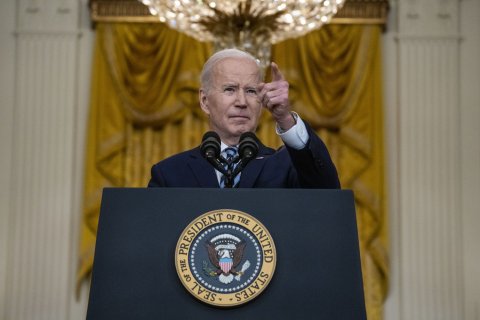
Within hours of the invasion, the United States and its allies responded by sharply ratcheting up economic sanctions but it's unclear whether the moves will deter the Russian leader. In a speech announcing the response, Biden said more than half of the West's high tech exports to Russia would be slashed, "degrading their industrial capacity," and hurting industries like aerospace and shipbuilding. He's also freezing the U.S. assets of four additional Russian banks, including VTB, the country's second largest financial institution, whose CEO is very close to Putin. "This is going to impose severe costs on the Russian economy, both immediately and over time," Biden said.
President Joe Biden takes questions after giving an update on the Russian invasion of Ukraine on Thursday, Feb. 24 in Washington, D.C.Kent Nishimura/Los Angeles Times/Getty
The following day, the White House announced it would join the European Union in implementing sanctions against Putin personally. The Russian President is widely thought to be one of the world's richest men, allegedly hiding much of his wealth in shell companies in various tax havens throughout the world.
How effective the sanctions will be is unclear. Putin, for his part, believes he has effectively made his country sanctions-proof. Russia has over $630 billion in hard currency reserves, and rakes in $14 billion per month in oil and gas exports. As Russia's ambassador to Sweden, Viktor Tatarintsev, told Swedish newspaper Aftonbladet days before the invasion began, when the West ramped up threats of financial penalties in a futile effort to prevent military action, "Excuse my language, but we don't give a shit about your sanctions."
Biden, in his remarks the day the invasion began, said he believes Putin may have brought himself a world of trouble by invading Ukraine. "History has shown time and again how swift gains in territory give way to grinding occupation, acts of mass civil disobedience and strategic dead ends," he said. And in fact, thousands of Ukrainian civilians have been training as part of newly formed "territorial defense organizations" set up in order to resist the Russians.
But U.S. intelligence officials privately do not share Biden's optimism about "mass disobedience." One official who spoke to Newsweek on background because he is not authorized to speak on the record said, "After the government in Kyiv is dismantled, there will be no opposition within Ukraine for us to support militarily."
His pessimism is rooted in Putin's past behavior, most notably when he presided over a scorched earth campaign to brutally put down an insurgency in Chechnya more than 20 years ago. He says, "It's not realistic to mount an opposition campaign. [Putin] does not value human life the same way that the free world does, hence [Russian troops] will eradicate any opposition en masse."
Indeed, Putin's history as a commander in chief of Russia's military shows that there may be reason to doubt Biden's optimism that Ukraine will turn into a quagmire for Moscow. Beyond the ruthless campaign to put down Muslim rebels in Chechnya, he hived off the two sections of the former Soviet state of Georgia that he wanted to control in 2008. Then in 2014 he took back Crimea in Ukraine, and set up separatist movements in two heavily Russian provinces in the east, Donetsk and Luhansk. (The day before the February 24th invasion, Putin declared those two provinces were now "independent republics." )
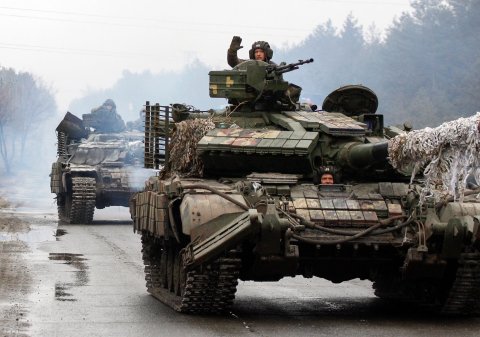
Ukrainian servicemen ride on tanks towards the front line with Russian forces in the Lugansk region of Ukraine on February 25, 2022. Anatolii Stepanov/AFP/Getty
And on the complex battlefield in Syria, where the U.S. and Russians risked conflict, former President Barack Obama funded opposition rebel groups, including some tied to Al Qaeda, then failed to enforce his own red line after President Basar Al Assad used poison gas on his enemies. Putin sent Russian troops in with one goal: that Assad maintain his grip on power. He remains in office to this day.
The Ultimate Goal
What is Putin's endgame now? The Russian leader is fueled by rage and seeks revenge against the West for his homeland's perceived mistreatment, says Peter Rough, a senior fellow at the Hudson Institute, a conservative think tank based in Washington. The country Putin grew up in, and the one he served as a KGB officer, dissolved in 1991. In its stead came chaos at home, and, in Putin's view, betrayal from abroad.
The demise of the Soviet Union, he has famously said, "was the most catastrophic geopolitical event of the 20th century" (worse, even, than World War II, in which 20 million Soviet citizens were killed). His resentment over what happened to his country, particularly in the immediate aftermath of the Soviet collapse, is more widely shared by Russians than many in the West appreciate.
As the Moscow bureau chief for this magazine in the early 2000s, I saw organized crime take over businesses large and small; the country's finances were in shambles. The government was unable to pay the salaries of a once proud military. I interviewed an Army colonel stationed on the Kamchatka Peninsula, in Russia's far east, who wept as he confessed he wasn't able to buy his wife a birthday present a few weeks earlier because he had not been paid his wages in months.
Boris Yeltsin, once the democratic hero who helped bring down the Soviet Union, had turned into a drunken mess as the first freely elected president of Russia; his inner circle was corrupt, enriching themselves as ordinary citizens struggled amidst the post Soviet chaos. On New Year's Day, at the dawn of the new millennium, Yeltsin stepped down. He was replaced by the man he had named Prime Minister months earlier, Vladimir Putin.
Twenty-two years later, in an extraordinary 55-minute speech to his country on Monday February 21, Putin aired many of his grievances in a way he rarely had publicly before, as a prelude to war. In it, he said, "Ukraine is not a separate country," and that "Ukrainians and Russians were brethren, one and the same." Kyiv, in his view, had been ripped unceremoniously from Mother Russia when the Soviet Union dissolved. He then recounted the West's early promise not to expand NATO.
He recalled how coldly then President Bill Clinton responded to his query, not long after he became President of Russia in 2000, about whether Moscow could ever be a member of NATO. He recalled, bitterly, how he was assured that NATO's expansion eastward—to include countries that had been members of the Warsaw Pact, Moscow's former client states—would "only improve their relations with us, even create a belt of states friendly to Russia.
Everything," Putin said, "turned out exactly the opposite. They were just words."
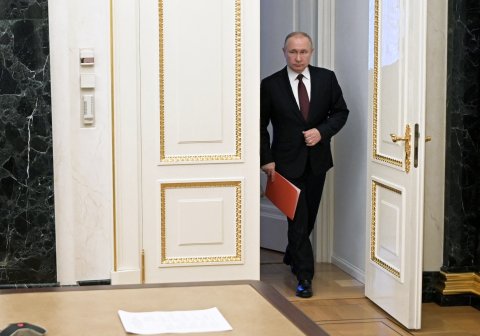
Russian President Vladimir Putin arrives to chair a Security Council meeting via a video link in Moscow on February 25, 2022. AlexeyNikolsky/AFP/Getty
How does Putin seek revenge for this betrayal? To the extent he can, he wants to piece together a new Russian Empire. Not necessarily every province of the former Soviet Union, but those parts of the pre-Soviet empire, established by the Tsars, who were largely Russian speaking, orthodox Christian and who looked first to Kyiv, and then later to Moscow, as the political, cultural and spiritual center of the world.
Putin is a nationalist first and foremost. Ukraine, plainly, is central to this vision. But it also includes the countries—former Soviet provinces—that are now effectively Russian client states (Belarus), as well as those Moscow wishes to control yet again: the Baltic states of Lithuania, Estonia and Latvia (the latter three are now members of NATO, for whom the alliance is obligated to fight in the event one of them is attacked.) Putin in his pre-invasion speech said it was "madness" that the Baltics were ever allowed to leave the USSR. He has demanded—preposterously—that the Alliance pull back to its 1997 stance, when there were just 16 members, as opposed to 30 today.
Point, Counterpoint
It is for that reason that Biden is moving more NATO troops and materiel into the Baltics. On February 25, NATO Secretary General Jens Stoltenberg said the Alliance would for the first time dispatch troops from the Spearhead Unit of its so-called Response Force—formed in 2014—to member states along the eastern front. NATO describes the Response Force as ''highly ready and technologically advanced." It consists of 40,000 troops from a variety of NATO countries. Stoltenberg declined to say precisely how many troops would be deployed now.
More deployments are likely in the months ahead. President Biden vowed in no uncertain terms that an attack on a NATO member would trigger Article 5, the provision that maintains any armed attack against one country in the Alliance is considered an attack against all. If Putin moves on the Baltics, or on any NATO members who formerly were part of the Warsaw Pact—like Poland, Romania or Bulgaria, all of which border Ukraine—then Moscow will be at war with NATO.
With the invasion of Ukraine, analysts believe, Putin hoped to shake NATO. He wanted, says Douglas Wise, a former CIA officer and deputy director at the Defense Intelligence Agency, "to further divide our allies, and cement existing fissures and disunity within [the Alliance] and the EU. He also believes he can benefit by humiliating the Western leaders and institutions when they fail to develop credible and practical options to counter his aggression."
Whether Putin benefits at home for his audacious attack on Ukraine is not yet clear. (There were small protests in major Russian cities in the immediate aftermath of the invasion.) But if creating more stress on NATO was one of his goals, that failed.
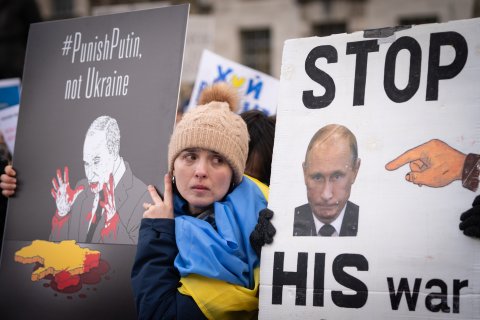
Ukrainians hold a protest against the Russian invasion of Ukraine outside Downing Street, central London.Stefan Rousseau/Getty
The Germans were widely viewed as the weakest link when it came to Russia, because of the two countries' significant trade ties. And at the outset of the crisis, that skepticism seemed justified. Early on, for example, Estonia wanted to send a batch of old howitizers in its possession to Kyiv. But NATO regulations say that any weaponry given or sold to a non-NATO member must be approved by the country of origin. In this case, that country did not exist: The howitzers had been in possession of the old East Germany. Upon unification, Germany took control of them and ultimately passed them on to Finland, who eventually gave them to Estonia. When Tallinn wanted to send them on to Ukraine, to do its bit to help shore up Kyiv's defenses, Germany—astonishingly—declined to approve the transfer.
That was followed by Berlin's deep reluctance to stop the Nord Stream 2 natural gas pipeline linking Germany and Russia, despite pressure to do so from its own ambassador to the U.S., Emily Haber. Following the refusal, Haber wrote a widely publicized cable to new Chancellor Olaf Scholz, saying that the country was gaining a reputation as a bad ally.
To Putin, this must have indicated that his gas-politik was paying huge dividends. But it didn't last long. Scholz visited Washington in early February and, in a post meeting press conference with Biden, stood by meekly as the president asserted that Nord Stream 2 was dead if Moscow took military action against Ukraine. On cue, hours after the invasion began last month, Germany halted certification of the $11 billion project.
In fact, far from deepening fissures within the alliance, Putin's Ukraine gambit has had the opposite effect. Former CIA Director and Army General David Petraeus, upon returning from the Munich Security Conference shortly before the invasion, said he had never seen the Alliance so unified since the days when he served at NATO headquarters during the Cold War.
The evident unity among the members of what Biden accurately called the most powerful military alliance in history, has only made the plight of Ukraine more poignant. As the invasion unfolded, a member of the Ukrainian parliament in Kyiv, Alexey Goncharenko, begged NATO to impose a no-fly zone, to allow his countrymen to have a fairer fight on the ground. There was zero chance of that happening, because Kyiv wasn't in the club.
Ukrainians flock to the train station to leave capital Kyiv after Russian military intervention in the country in Kyiv, Ukraine on February 25, 2022. Wolfgang Schwan/Anadolu Agency/Getty
Soon now, its desire to be part of the West will be moot, as Putin's Russia takes control—little more than 24 hours after the invasion began, Russian forces were already entering the the capital and Kyiv was hit with Russian "cruise or ballistic missiles." Success is inevitable because Biden and the allies have made it clear that Moscow will not meet military resistance from the West. Over and over Biden has told the American people the U.S. will not fight on the ground in Ukraine. He knows the public has no stomach for it.
If events play out as military analysts now expect, the conflict will end relatively quickly with a negotiated settlement that may cede some territory to Russia, the installation of a new Russia-friendly regime in Kyiv and a partial withdrawal of troops that allows Putin to avoid the quagmire the West so badly wants him sucked into. In doing so, Putin will be able to claim that he dealt a devastating setback to NATO, the main goal of his aggression.
For Putin, the sack of Ukraine will likely mark the endgame in his desire to restore the empire. If it doesn't, it will mean at some point the world's two largest nuclear powers will be in a shooting war, with all the risk that entails. With his words and more importantly his actions, Biden is frantically signaling to Putin: this far, but no further. An anxious world hopes the Russian leader, satisfied with victory in Ukraine, will get the message.
In Joe Biden's America, attempting to cancel Joe Rogan is just counter-terror policy.
This is because our ruling class—in the name of "defending democracy"—classifies those who question the regime on any matter of consequence as a threat to the homeland, and pledges to pursue them accordingly.
Our ruling elites have engaged in an overt war on wrongthink masquerading as a domestic counter-terror mission since at least January 6, 2021.
Among the greatest contributors to the current "threat environment," according to the bulletin, is the "widespread online proliferation of false or misleading narratives regarding...COVD-19."
It would appear the Biden administration considers the ivermectin-hocking, tequila-swigging, Bernie Sanders-supporting Rogan to be public enemy number one on this issue.
Shortly after hosting dissenters from COVID orthodoxy including Drs. Peter McCullough and the then-recently deplatformed Robert Malone on his podcast, Rogan found himself the subject of a cancel campaign contrived by washed-up musicians, non-medical doctors and corporate media whose ratings he has crushed.
This effort was, to put it mildly, disingenuous. We know how seriously to take the administration's views on COVID "misinformation and disinformation" because by its own standards the White House, and its media mouthpieces, have been the most powerful and prolific purveyors of "misinformation."
The administration has flip-flopped on virtually every aspect of the coronavirus to positions that its social media adjuncts used to ban people over. It did so not because "the science" has changed, but because the politics have changed.
Biden's White House says its critics are dangerous—not to the public, but to its rule, as if that rule is equivalent to America or democracy itself, as Dr. Anthony Fauci is to science.
As the DHS bulletin notes, the first key driver of the "heightened threat environment" is the "proliferation of false or misleading narratives, which sow discord or undermine public trust in U.S. government institutions."
Never mind what those government institutions themselves have done to sow discord or undermine public trust, like, say, calling for Twitter and Facebook to censor people.
It's the critics, the dissenters—those with no monopoly on force or multi-trillion-dollar budgets—who are the real scourge.
The bulletin lists as another potential threat "false or misleading narratives regarding unsubstantiated widespread election fraud"—perpetuating the narrative of "insurrection" so central to the effort to persecute wrongthinkers, while eliding that Democrats' own election integrity-eroding measures destroyed confidence in the system.
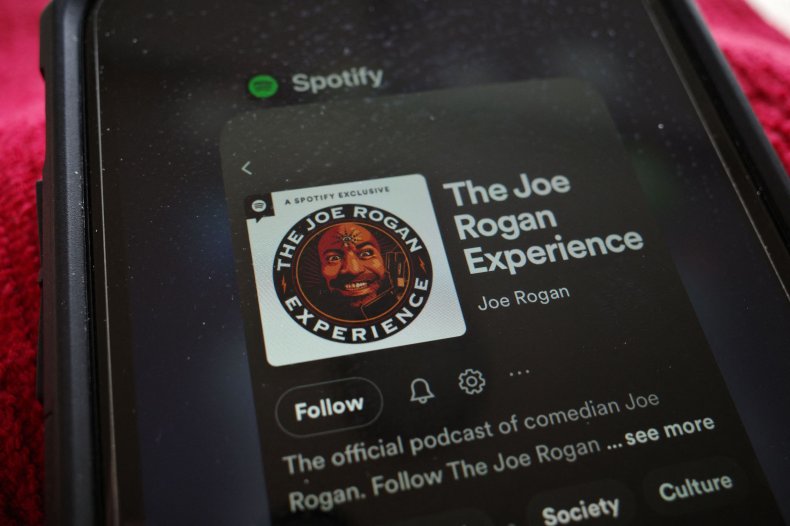
This illustration photo shows the Spotify page for "The Joe Rogan Experience" podcast displayed on a smart phone in Washington, DC on February 7, 2022. - The head of music streaming giant Spotify Daniel Ek has condemned podcaster Joe Rogan's use of a racial slur but insisted that silencing him was not the answer.MANDEL NGAN / AFP/Getty Images
Previous Biden-era bulletins similarly focused on COVID-19 and election integrity, but the latest one—in a new twist—also claims that calls for violence have been tied to anger over "the evacuation and resettlement of Afghan nationals following the U.S. military withdrawal from Afghanistan."
So it's not just questioning the merits of mask and vaccine mandates, or skepticism over the security of mass mail-in elections, but doubts about the wisdom of dropping unvetted refugees from a terror-dominated backwater into the middle of your town that could get you in trouble with the security state.
That strategy calls for confronting long-term contributors to domestic terrorism, including:
enhancing faith in government and addressing the extreme polarization, fueled by a crisis of disinformation and misinformation.... We will work toward finding ways to counter the influence and impact of dangerous conspiracy theories that can provide a gateway to terrorist violence.
Linking speech that does not comport with regime orthodoxy to terror, and using that pretext to police thought—with an armed Ministry of Truth operating out of our national security and law enforcement apparatus—therefore manifestly is "counter-terror" policy.
Casting critics as terrorists and threatening to sic the most powerful, pervasive and sophisticated security state in the history of the world on them is of course not about defending democracy or protecting the truth, but intimidating democratic opposition into silence and submission to an official narrative.
The regime evidently believes it must maintain a monopoly over the American mind to maintain a monopoly on power.
Joe Rogan threatened that power, and therefore constituted a danger. The threat was that he elicited insights from guests who challenged the regime's credibility on all manner of issues related to COVID, and millions of people heard it.
Trump and his allies likewise threatened that power, and therefore constituted a danger. They were—and continue to be—pursued like terrorists, as the House January 6 Committee wields the full force of the federal government to investigate them, surveil their communications and audit their dealings. Why? Trump and his allies called the regime a failure, stated undeniable truths that resonated with Americans to justify that view and supported policies aimed at rectifying said failures that would disempower the ruling elites.
The most meek and unthreatening of January 6 defendants now face extreme, hyper-political prosecutions. They are being made an example of not because they ever posed a credible threat to the regime's power, but as a signal to the millions of peaceful, patriotic Americans who might—through their collective speech, advocacy and voting.
The same goes for the parents outraged over anti-scientific and detrimental COVID-19 policies, and over critical race theory indoctrination in schools. The Department of Justice threatened to pursue them like jihadists—not because they are jihadists, but because parents awakened to the regime's corrupt monopoly on the all-important institution of education could break that monopoly and end the careers of the politicians who support it. They must therefore be chilled.
The war on wrongthink is not about left or right. It's about who rules: a sovereign people or the elites who deign to lord over us.
The ruling class—the "defenders of democracy"—sees citizens on the left and right opposed to its agenda and refuses to address their concerns peaceably. Instead, it calls them terror threats and pursues them using the full power of the public and like-minded private sectors.
The ruling class does not fear misinformation and disinformation. It fears truth, particularly the truth about its own rot, corruption and incompetence, which calls into question its authority.
This leaves us with a question: when everyone, from unorthodox presidents to curious podcasters to caring parents are deemed existential threats to the regime, how strong is the regime?
Russiagate, the collective delusion that Donald Trump was secretly a Russian agent aided and abetted by the Kremlin, the topic of uncountable inches of Washington Post and New York Times copy and the entire primetime lineup of MSNBC, was a dirty trick by the Hillary Clinton campaign. Not just part of it. All of it. One of the most diabolical, successful misinformation campaigns ever concocted.
We already knew that the Steele dossier was garbage. Christopher Steele was paid indirectly by the Clinton campaign to dig up dirt, which he did by turning to other Clinton operatives, laundering every outlandish rumor about Trump he could find into an “investigative” document.
He shopped it to the FBI, which couldn’t verify his sources or any of his stories, but the agency dragged out the investigation to cast maximum suspicion on the new president. In the meantime, Steele found willing accomplices in the media to push his propaganda. The dupes at BuzzFeed even decided to print the whole pack of lies, with the flimsy rationale of “Well, why not?”
Democrats are calling for Clinton to be investigated for her role in Russiagate.Masterclass via REUTERSPresident Donald Trump holds up papers as he speaks about the coronavirus in the James Brady Press Briefing Room.Alex Brandon/AP
We got to the point where New York magazine was running a cover story that was one long piece of fan fiction that Trump was secretly a real-life version of “The Americans,” a sleeper agent now seated in the highest office in the land. The Times and Washington Post won a freaking Pulitzer!
A made-up story
Now another piece of Russia, Russia, Russia is kaputski. A computer server operated by Trump’s company was secretly communicating with a Russian firm, claimed Slate magazine and endless Twitter threads of would-be tech experts.
But as special counsel John Durham outlines in his latest indictment, that was just a story made up by tech executive Rodney Joffe, who desperately wanted a job with the Clinton administration. He hacked Trump’s servers, cherry-picked privileged Internet data he had access to, and molded it to look like something nefarious.
Recent Durham filings have shown that Trump’s suspicion that he was being spied on was true.Bob Child/AP
He was coached by lawyer Michael Sussmann — who was being paid by the Clinton administration, although he lied about that to investigators. Sussmann goes to the FBI as a “concerned citizen” — not a “Clinton stooge” — to try to get them to bite. The ultimate goal: Be able to leak to the Times that Trump is under official investigation.
Durham “definitely showed that the Hillary Clinton campaign directly funded and ordered its lawyers at Perkins Coie to orchestrate a criminal enterprise to fabricate a connection between President Trump and Russia,” says Kash Patel, the former chief investigator for the House Intelligence Committee.
Beyond outrageous
Of course, Hillary didn’t get what she wanted — the presidency. But her operatives didn’t stop, going on CNN to give “very concerned” interviews about a theory they knew was bull. All to undermine Trump’s presidency. It would take three years for the Mueller report to finally put the lie to rest, and we’re now, five years out, at the point where Durham is detailing the full conspiracy.
If this had happened to a Democrat, the press would be losing its mind. A candidate for president weaponized the nation’s Justice Department to pursue an investigation into their political opponent based on what they knew were lies. Americans were wiretapped! Some were entrapped for flimsy claims of perjury. The director of the FBI went into the Oval Office to tell the president that there was a sexual rumor floating around, so that it could be promptly leaked to the media. “Outrageous” doesn’t cover it. And still no shame from Hillary Clinton and her supporters, because it’s Donald Trump — anything is fair game to take him down.
All these things we’ve been lectured about over the past four years: Norms being broken, internet misinformation, perversion of government — it was all happening. It was the Democrats who were doing it. Think anyone in the left-wing media will notice?
[ISIS-K consists of mercenary "Islamists", mostly ex-TTP, who have been hired by ISIS in Syria to create the impression of a growing worldwide "Caliphate". Originally recruited from anti-Shiite/Hazara mass-murderers in Pakistan and Afghanistan, to come to Syria and continue their work there. After being run-out of Pakistan by Pak Zarb-i-Azb military offensive, the TTP, soon to be ISIS-K, were sheltered for several years in Afghanistan by local Pushtuns and the Afghan secret services until they became useful. The Afghan Govt supported a Khorasani offensive against the Afghan Taliban, until they were severely beaten by the Talib and thereafter kept penned-up in and around Nangarhar (Afghan Taliban Keep ISIS Penned-Up In The Wilderness of Nangarhar https://therearenosunglasses.wordpress.com/2016/11/27/afghan-taliban-keep-isis-penned-up-in-the-wilderness-of-nangarhar/). After the Taliban victory, Taliban found them useful, using them to attack the Americans and the airport, making new American media disinformation (Trusting the Taliban to Fight Islamic State https://www.bloomberg.com/opinion/articles/2021-08-27/the-u-s-may-be-relying-on-the-taliban-to-fight-islamic-state-bad-move) seem probable, allowing the CIA to continue and to expand Afghan operations under the watchful Taliban eye. https://www.foxnews.com/world/kabul-explosion-signals-opening-of-jihadi-civil-war-in-afghanistan[
The top US commander in Afghanistan General John Nicholson has said roughly 70 per cent of the Islamic State of Iraq and Syria (ISIS) terror group loyalists fighting in Afghanistan are the members of Tehrik-e-Taliban Pakistan.
“In the case of Islamic State Khorasan province, the majority of the members are from the Tehreek-i-Taliban Pakistan (TTP).”
A former member of the U.S. State Department said the real purpose of Thursday's suicide attack in Kabul, which killed 13 U.S. service members and scores of Afghans, was "an opening salvo of a civil war ISIS-K is seeking to fight against the Taliban."
The ISIS-K suicide bombing marked the deadliest day for American forces in Afghanistan since August 2011.
In an interview with Fox News, Christopher Harnisch, former deputy coordinator for counterterrorism at the U.S. State Department, broke down the terrorist group’s motivation for the attack amid the U.S. completing its withdrawal from the country.
"We in the West tend to think of the target being Americans," Harnisch told Fox News. "The real purpose was to attract potential recruits into its ranks, and also to really launch a civil war against the Taliban and other groups fighting along the periphery."
The group, known as Islamic State Khorasan Province or ISIS-K, is an Afghan affiliate of the group's core leadership in Syria and Iraq. After the Islamic State lost its territory following a five-year military campaign by local and international forces, the caliphate increasingly turned to Afghanistan for its fighters.
ISIS-K was founded in 2015 by several hundred disillusioned Pakistani Taliban fighters. According to Harnisch, the goal of all ISIS factions is "to establish a global caliphate governed by the most extreme and oppressive interpretation of Sharia."
"With the withdrawal from Afghanistan, ISIS-K sees an opportunity to fill a security vacuum and ultimately try to come to power," he continued.
In order to gain control of the region, ISIS-K will have to fight the Taliban, which just toppled the U.S.-backed government in Afghanistan after a 10-day blitz and currently sits at the helm of the country.
In addition to sparking a civil war with rival militant Islamist jihadi groups, another reason for the attack was to aid the terrorists group's global recruitment effort.
"ISIS-K knows that in order to achieve success and achieve its vision of setting up a caliphate based in Afghanistan, it's going to need manpower," said Harnisch.
A United Nations report in June found that 8,000 to 10,000 jihadists from Central Asia, the North Caucasus region of Russia, Pakistan and the Xinjiang region in China have entered into Afghanistan in recent months. According to the report, most are associated with the Taliban or Al Qaeda, the report said, but others are allied with ISIS-K.
"ISIS-K’s objective was to undermine the credibility of the Taliban by showing Afghans and the world that the Taliban is incapable of providing security," Harnisch claimed. "The attack was a huge propaganda victory," he continued. "Aspiring jihadists all over the world saw that and they're saying, ‘ISIS is the one in charge here.’"
While ISIS-K’s estimated 1,500-2,000 members pale in comparison to the Taliban’s near 80,000, Harnisch said he believes the number of ISIS-K recruits entering into Afghanistan will increase over the coming months following Thursday’s attack.
When comparing ISIS-K with the Taliban and Al Qaeda, Harnisch said "tactically speaking they're very similar," with all three engaging in "absolutely barbaric, evil terrorist attacks."
However, he admitted that ISIS-K’s attacks "tend to be about as far on the spectrum of evil as you can possibly be."
Harnisch specifically recalled an incident in 2020 in which ISIS-K targeted the maternity ward of a hospital in Kabul, killing 24 people including newborn babies and mothers.
"The Taliban and al-Qaida, though evil organizations and barbaric in their own right, haven't gone that far in terms of their attacks," he said.
Despite the Unites States’ desire to disengage from long, drawn-out international conflicts, Harnisch claimed, "the fight against terror, it will continue."
The former Counterterrorism Director at the National Security Council criticized .U.S leadership for its false promise to "end forever wars."
"We ended the war in Afghanistan, but I can tell you right now that the war against terror is not over," he said. "It will continue because we just handed the Taliban, ISIS and al Qaeda, a major victory."
Saqib Qureshi , visiting fellow, London School of Economics
You've
probably read a lot about Afghanistan in the past week, more perhaps
than at any time in recent memory. There are any number of hot takes,
articles, op-eds and analyses of the Taliban,
the U.S. withdrawal and the geopolitical implications of the fall of
Kabul. These are all very valuable topics that are worth discussing. But
what is curiously missing from much of the conversation is how this
failed war had been extensively outsourced to nontransparent and
unaccountable actors.
A purported war for a democratic Afghanistan pursued in glaringly undemocratic ways.
It
behooves America to consider how and why so much of such a vital
conflict was assigned to private contractors—and whether that kind of
approach was even partly to blame for the debacle that ensued. It might
be. That is not even to broach the topic of whether so much of the
world's most powerful country's foreign policy should be in the hands of
corporations that do not answer to the people footing the bill, namely,
the taxpayer. I would have expected more Americans to be outraged.
Perhaps,
one can hope, that outrage will swell over time, as more Americans come
to learn of what exactly transpired—and how much of their treasure was
squandered. I must insist journalists do their part to follow the money.
We cannot let this story slip from the headlines without demanding
accountability. Even a cursory examination of what happened would
provoke great consternation—revealing, at times, a grim and tragic
comedy of errors.
Afghanistan
is an unforgiving and mountainous country. One reason perhaps it is
called "the graveyard of empires." A whopping 1 percent of the country
is thickly forested, which makes the decision of a singular Afghan
official—as I detail in my recent book, The Broken Contract—to
demand forest camouflage uniforms for the Afghan National Army to be
absurd. Nevertheless, each American paid about $.25, for a total $28
million for these marginally useful uniforms.
Perhaps the
camouflage did some good, though—after all, the Afghan National Army all
but disappeared from view in a very short span of time.
The
deeper we dig, the more upsetting the numbers and corruption get. The
Special Inspector General for Afghanistan Reconstruction (SIGAR) found
that, in 2018, some $15 billion dollars of government funds were wasted, used fraudulently,
or otherwise abused. A further $8 billion was spent on buildings and
vehicles since 2008. Astoundingly, less than 10 percent of that outlay
was in good condition, although of course that may be a blessing in disguise, given said military's collapse.
Otherwise, the Taliban would have still more American weapons
and supplies on hand. Weapons and supplies that will be used to
suppress the Afghan people. We can be thankful that some brave Afghan
pilots flew their aircraft
out of the country, preventing some of that advanced weaponry from
falling into the hands of the Taliban. Of course, not all the aircraft
made it out, and who's to say the Islamic Emirate of Afghanistan won't trade that technology to American rivals in exchange for aid and investment?
It happened before,
after all, when the Chinese got their hands on an American aircraft
that had crashed during the Abbottabad raid that killed Osama bin Laden.
All of these numbers, added together, total around $83 billion, which is the amount of money that went to build up the capability
of the Afghan National Army. There is another still more eye-popping
amount that should be considered. It is estimated that America spent
close to $2 trillion over the course of the entire Afghanistan war,
to say nothing of the many Americans who lost their lives, the many
more who are seriously injured and the even more who are traumatized.
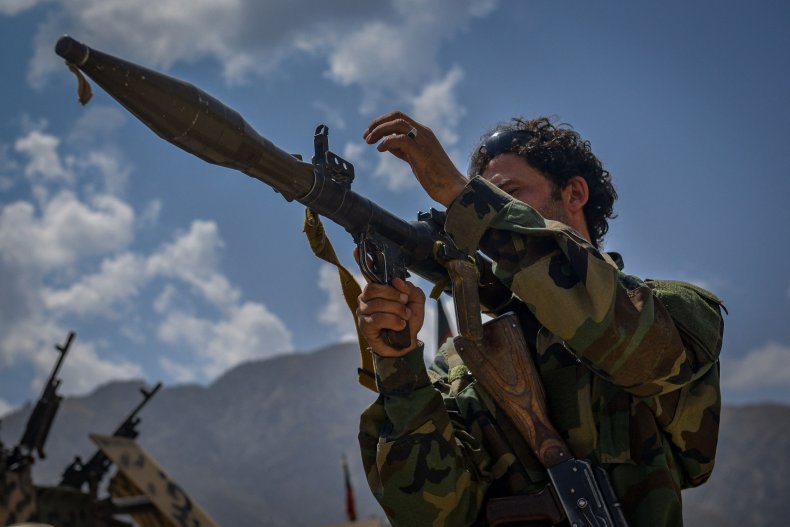
An armed man supporting the Afghan security forces
against the Taliban pictured with weapons at Parakh area in Bazarak,
Panjshir province on August 19, 2021. AHMAD SAHEL ARMAN/AFP via Getty Images
Could it be that a culture of outsourcing and a culture of contractors is partly to blame?
Consider
that this spring there were still some 7,000 contractors in
Afghanistan, helping to run its military and keep its Air Force in good
order. Why, one wonders, would America build up a military it knew could
not sustain itself if America's intention was to eventually hand power
back to the Afghans? Could it be that war profiteers and their allies
hoped to reap handsome profits from continuing non-governmental
relationships even after the United States officially departed the
country?
An
Afghan National Army under severe pressure from the Taliban would be
consistently desperate for ammunition and expertise, leading to a
potentially wildly lucrative opportunity. Of course, we cannot know
until we investigate further, even as this is in the immediate moment a
theoretical exercise. The Afghan National Army has apparently
disappeared. But shouldn't we ask why? Shouldn't we wonder what
happened? Shouldn't we ask how this happened?
To know whether we
should go to war in the future, and if circumstances demand that, how we
should go to war as well. With the Taliban slipping back into their brutal patterns,
it goes without saying that these questions receive greater urgency. At
the very least, we should be heartened that the Taliban's manipulation
and perversion of my religion are not inescapable. In the past,
Afghanistan was a more liberal and tolerant place, which means it is
possible to be that again.
We owe it to the Afghan people to understand whether our decisions made that future more likely or less likely.
Just as American citizens deserve transparency and honesty, so do the people of Afghanistan.
Dr. Saqib Qureshi is author of the Broken Contract: Making Our Democracies Efficient, Representative, and Accountable.
He is an award-winning author, an expert in democratic policy
development and has advised multiple governments. He is the CEO of the
top Toronto-based real estate firm Building Capital, and previously
worked at HSBC Investment Bank and McKinsey & Co. He has written for
The Financial Times, The Wall Street Journal, HuffPost, Entrepreneur, Euronews and TRTWorld. In addition he is author of the award-winning book Reconstructing Strategy: Dancing with the God of Objectivity. He is currently a visiting fellow of the London School of Economics (LSE).
The views expressed in this article are the writer's own.