No Sunglasses

Alternate blog for There Are No Sunglasses: therearenosunglasses.wordpress.com

Thursday, October 2, 2025

Trump Informs Gathering of Generals and Admirals To Prepare for War Against Democrat Cities

The U.S. armed services have long sought to preserve the tradition of a nonpartisan military.

Helene Cooper

In the middle of Tuesday’s rambling speech at Marine Corps Base Quantico in Virginia, President Trump told hundreds of the country’s military commanders his latest thinking on where they should next set their sights.

Not Poland, or Romania, or Estonia or Denmark, all NATO allies where Russian drones have in the past month violated airspace in a challenge to the alliance’s borders.

The president chose San Francisco. Chicago. New York. Los Angeles.

“We’re going to straighten that out one by one, and this is going to be a major part for some of the people in this room,” Mr. Trump told the generals, admirals and enlisted leaders, referring to what he has described as crime-filled urban hellscapes.

“It’s a war from within,” he said.

In that moment, the president again pitted himself against the wishes of the country’s founding fathers, historians and former military leaders say.

Mr. Trump’s suggestion that “we should use some of these dangerous cities as training grounds for our military” is in tension with a core principle that the country’s armed services have long sought to preserve — that the military should be nonpartisan.

This principle, with its deep roots in American democratic traditions, is meant to ensure that the standing army initially feared by the country’s founding fathers serves the nation as a whole, and not one political party or leader.

That military was meant to be directed at foreign enemies, not the “enemy from within,” as Mr. Trump said on Tuesday.

Mr. Trump has tried this before.

During Mr. Trump’s first term, Defense Secretaries Jim Mattis and Mark T. Esper and the chairmen of the Joint Chiefs of Staff, Gen. Mark Milley and Gen. Joseph Dunford, tried to prevent the president from using the military domestically to further his political agenda.

When Mr. Trump demanded a deployment of 10,000 to 15,000 military troops to fend off what he called a migrant “invasion” at the southwest border, Mr. Mattis responded by sending 6,000 National Guardsmen, and told them to make sure to stick to support roles and to steer clear of migrants.

When Mr. Trump wanted to send the 82nd Airborne onto the country’s streets during social justice protests, Mr. Esper called a news conference to announce his opposition, for which he was eventually fired.

Those men are now gone, and the men Mr. Trump has installed in their place in his second term have either amplified his wishes or bowed to them.

Gone too is the congressional opposition that blocked Mr. Trump during his first term. Republicans control both the House and the Senate, and have acquiesced to all of Mr. Trump’s directives and appointments that relate to the American military.

The result: National Guard troops deployed in Washington against the wishes of the city’s elected leaders. Active-duty Marines sent to Los Angeles over the protests of the mayor and governor. Books by writers of color, including Maya Angelou’s “I Know Why the Caged Bird Sings,” banned from the library at the U.S. Naval Academy. A Pentagon leadership that refuses to promote decorated combat soldiers who served under men Mr. Trump dislikes. A plan to use military lawyers, known as JAGs, as immigration judges. And Mr. Trump’s promises to send National Guard troops to more American cities.

Armed National Guard soldiers in uniform stand in front of the Washington Monument.
National Guard troops in Washington, where they were deployed against the wishes of the city’s elected leaders.Credit...Haiyun Jiang/The New York Times 

“We genuinely are at a fraught moment,” said Kori Schake, a former defense official in the George W. Bush administration who directs foreign and defense policy studies at the American Enterprise Institute in Washington.

In her upcoming book, “The State and the Soldier,” Ms. Schake argues that after navigating more than two centuries of changing political winds, the American military is being challenged in ways that could redefine it.

Deploying troops inside the country as an arm of law enforcement is not what the founding fathers wanted, military historians say. They feared that the government could use a standing army to suppress dissent and establish tyranny.

Over 250 years, American political and military leaders built what is widely viewed as the world’s most competent fighting force. Its 1.3 million active-duty troops and 765,000 reserve and National Guard troops have answered to civilian leaders, whether Democrat of Republican, saluting whomever the American people elected as president.

But now the military, which has long prized its nonpartisan role in society, has a commander in chief who is not only breaking that tradition, but also targeting domestic, instead of foreign, threats.


“If I was the leader of the Polish military, and we’re getting Russian incursions into NATO territory, and I saw 800 American generals and admirals sitting in an auditorium listening to that speech, well, that would grate,” said Maj. Gen. Paul D. Eaton, an Iraq war veteran who is retired. “Is the American military serious?”

The Posse Comitatus Act, an 1878 law, generally bars active-duty forces from providing domestic law enforcement.

Essentially, it holds that the military should be pointed outward and not inward.

But its origins were less laudable. Congress passed the act to placate white supremacists in the South who didn’t want the military blocking state and local Jim Crow-era segregation laws.

The period after the Civil War was hugely tumultuous. The American government won the Civil War, but in many ways it lost the years that followed to white supremacists, who stripped Black Americans in the Southern states of their newfound rights.

The Southern states didn’t want federal troops coming in to protect Black people. Weary of the battle, and in an effort to appease the those states, Congress passed the Posse Comitatus Act.

The framers of the American Constitution were students of history, heavily shaped by the English Civil War, in which King Charles I asserted the divine right of kings, tried to rule without Parliament, and used his army against his own people.

The framers also were heavily influenced by the British military’s occupation of the colonies.

They were cleareyed about what they considered the biggest potential danger: that a standing army could be turned against the people it was supposed to protect.

But they were also realists and acknowledged the need for a military to defend the country.

“The continual necessity for his services enhances the importance of the soldier, and proportionably degrades the condition of the citizen,” Alexander Hamilton wrote in the Federalist Papers. “The military state becomes elevated above the civil.”

America got its army, but the constitutional framers gave Congress, not the president, the power to raise and fund it. And they gave the Senate, through the “advice and consent” clause, the power to approve or reject the people appointed by the president to lead the military.

The founding fathers “took great pains to try and divide power, and to give so much of it to Congress,” said Carrie A. Lee, the former chair of the department of national security and strategy at the Army War College.

The framers, she and other historians said, sought to balance power between the two branches for a less partisan approach.

They may not have anticipated a Congress that would not use the power given to it.

To be sure, American history is full of examples of presidents using the military for domestic purposes.

President Dwight Eisenhower did in 1957, when he sent the Army’s 101st Airborne Division to Little Rock, Ark., where state National Guard troops were keeping nine Black students from entering school under the orders of the segregationist Gov. Orval Faubus.

National Guard troops protecting civil rights activists during a march in Selma, Ala., in 1965. The troops were ordered there by President Lyndon B. Johnson.Credit...Associated Press

President Lyndon B. Johnson federalized National Guard troops in Alabama in 1965 to protect civil rights activists marching for voting rights after state and local police attacked previous marchers with billy clubs and tear gas.

In both cases, the presidents used the deployments to enforce the law. For Mr. Eisenhower, it was the Supreme Court’s Brown v. Board of Education. For Mr. Johnson, it was the Civil Rights Act, which legally ended segregation in public accommodations, employment and federally funded programs, and was the forerunner to the Voting Rights Act passed by Congress a few months later.

Mr. Trump argues that the National Guard is needed to help federal forces crack down on crime.

But those earlier instances were during periods of intense civil difficulty and danger — specific crises that precipitated the deployment of troops.

By contrast, Mr. Trump is ordering National Guard troops to cities that are not experiencing widespread civil disturbance, said Peter Feaver, a political science professor at Duke University who has studied the military for decades.

“Since there is not the generalized breakdown in civil order, or a global crisis, that makes a nonpartisan case harder to make, and we’re left with the partisan interpretation,” he said. “And that is toxic for military professionalism because they do not want to be deployed in narrow partisan missions.”

A crisis came just after the end of the Civil War and the assassination of Abraham Lincoln. It was a moment that led to what became a fundamental military norm: While you are in service you do not serve a political party, you serve the law of the land.

In Congress, Lincoln’s Republican Party sought to expand basic rights to the former slaves.

Congress passed the First Reconstruction Act, requiring each state to pass the 14th Amendment. This was a direct message to still-rebellious Southern states that they would be considered only “military districts” unless they gave former slaves citizenship status.

But President Andrew Johnson, who was hostile toward former slaves and in favor of more lenient policies toward the Southern states, vetoed the act.

Congress overrode his veto.

Johnson worried that Ulysses S. Grant — the country’s most senior general, a man who was credited with winning the Civil War — would side with Congress. Grant was wildly more popular than Johnson.

Johnson tried to send him on a diplomatic mission to Mexico. In a testy cabinet meeting, Grant refused to go, arguing that as a military officer, he carried out only military orders from the president.

Johnson asked the attorney general for a ruling on the constitutionality of Grant’s refusing a direct order. The attorney general supported Grant’s position.

With Johnson and Congress on a collision course, Grant was called to testify before the House Judiciary Committee, which was considering impeaching Johnson.

At its heart, this was a crisis over constitutional power, and Grant sided with Congress.

“When forced, he made the most democratic choice on the most fundamental issue, which is that, in peacetime, it is the Congress’s authority that is supreme in matters of military policy,” Ms. Schake said in an interview.

For his part, Grant also worried that Johnson was becoming authoritarian, writing that “we are fast approaching the point where he will want to declare the body (Congress) illegal, unconstitutional and revolutionary.”

The significance of Grant’s break with Johnson lies in his interpretation of the limits on presidential authority over the military: While you are in service you do not serve a political party, you serve the law of the land.

Military policy and norms evolved from Grant’s example. The military discourages political rallies in front of troops, and those on active duty are urged to avoid partisan politics. Political affiliation is not supposed to be a factor in the vetting of senior officers.

Many military leaders say one big reason the American public regards its military so highly is that troops are usually not seen as advancing political agendas.

Using the military in partisan domestic matters “detracts from much-needed focus on 21st century warfighting challenges,” said Maj. Gen. Charles J. Dunlap Jr., a retired deputy judge advocate general in the military. “China, Russia, Iran, North Korea and others aren’t going to be deterred by battalions of immigration judges or troops who are occupied by immigration duties on city streets instead of the harsh environs of the National Training Center preparing to fight a peer competitor in high-intensity combat.”

At the gathering on Tuesday, Mr. Trump looked into the crowd of military commanders and spoke about his vision for the future.

“You’ll never see four years like we had with Biden and that group of incompetent people that ran this country that should have never been there,” Mr. Trump said.

“With leaders like we have right here in this beautiful room today, we will vanquish every danger and crush every threat to our freedom.”


Helene Cooper is a Pentagon correspondent for The Times. She was previously an editor, diplomatic correspondent and White House correspondent.
 

Wednesday, October 1, 2025

The "War On Terror" Has Come Full Circle...WE THE PEOPLE Are Now the Primary Target

Trump’s NSPM-7 Labels Common Beliefs As Terrorism “Indicators”

New directive targets “anti-Christian,” “anti-American,” and “anti-capitalism” opinions


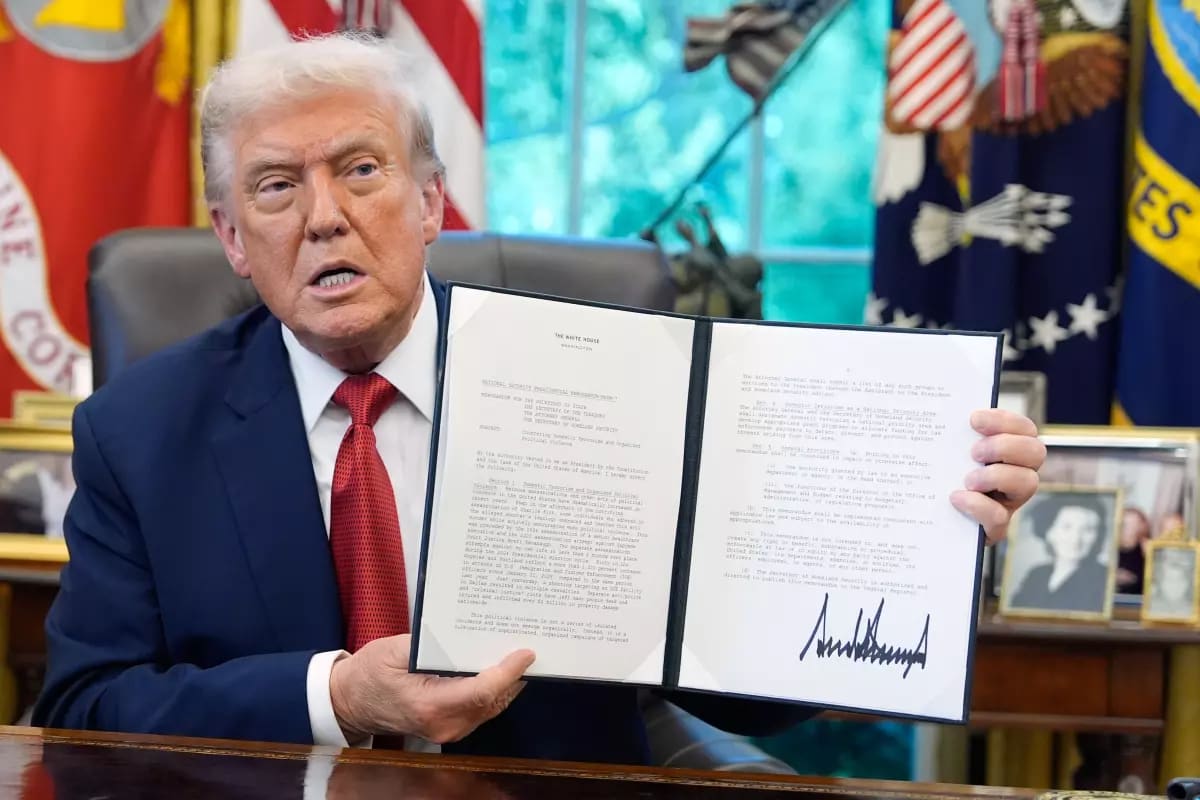
With the mainstream media distracted by the made-for-TV drama of James Comey’s indictment, Trump has signed a little-noticed national security directive identifying “anti-Christian” and “anti-American” views as indicators of radical left violence. Called National Security Presidential Memorandum 7, it’s being referred to as “NSPM-7” by administration insiders.

“This is the first time in American history that there is an all-of-government effort to dismantle left wing terrorism,” Trump’s homeland security advisor Stephen Miller said, referring to the issuance.

To the extent that the major media noticed the directive at all, they (even C-SPAN!) incorrectly labeled it an “executive order,” like this week’s designation of “Antifa” as a domestic terrorist organization.

It’s hard to overstate how much different NSPM-7 is from the over 200 executive orders Trump has frantically signed since coming back into office.

An executive order publicly lays out the course of day-to-day federal government operations; whereas a national security directive is a sweeping policy decree for the defense, foreign policy, intelligence, and law enforcement apparatus. National security directives are often secret, but in this case the Trump administration chose to publish NSPM-7 — only the seventh since he’s come into office.)

Previous national security directives have been controversial, even politically earthshaking. In 1980, for example, President Jimmy Carter signed the Top Secret Presidential Directive 59 (“PD-59”) directing new nuclear warfighting policies that persisted until the end of the Cold War. When revealed, PD-59 caused a public furor.

Similarly, President George W. Bush signed a series of classified national security directives after 9/11, the most famous of which authorized NSA’s unlawful domestic intercepts, a directive that wasn’t publicly revealed until four years later.

In NSPM-7, “Countering Domestic Terrorism and Organized Political Violence,” President Trump directs the Justice Department, the FBI, and other national security agencies and departments to fight his version of political violence in America, retooling a network of Joint Terrorism Task Forces to focus on “leftist” political violence in America. This vast counterterrorism army, made up of federal, state, and local agents would, as Trump aide Stephen Miller said, form “the central hub of that effort.”

NSPM-7 directs a new national strategy to “disrupt” any individual or groups “that foment political violence,” including “before they result in violent political acts.”

In other words, they’re targeting pre-crime, to reference Minority Report.

The Trump administration isn’t only targeting organizations or groups but even individuals and “entities” whom NSPM-7 says can be identified by any of the following “indicia” (indicators) of violence:

  • anti-Americanism,
  • anti-capitalism,
  • anti-Christianity,
  • support for the overthrow of the United States Government,
  • extremism on migration,
  • extremism on race,
  • extremism on gender
  • hostility towards those who hold traditional American views on family,
  • hostility towards those who hold traditional American views on religion, and
  • hostility towards those who hold traditional American views on morality.

“The United States requires a national strategy to investigate and disrupt networks, entities, and organizations that foment political violence so that law enforcement can intervene in criminal conspiracies before they result in violent political acts,” the directive states (emphasis mine).

A “pre-crime” endeavor, preventing attacks before they happen, is core to the post-9/11 concept of counterterrorism itself. No longer satisfied to investigate acts of terrorism after the fact to bring terrorists to justice, the Bush administration adopted preemption. Overseas, that led to aerial assassination by drones and “special operations” kill missions. Domestically, it led to a counter-terrorism campaign whose hallmark was excessive and illegal government surveillance and the use of undercover agents and “confidential human sources” to trap (and entrap) would-be terrorists.

Now, with Donald Trump’s directive retooling the counter-terror apparatus to go after Americans at home, this means monitoring political activity, or speech, as an investigative method to discover “radicalism.” (Contrary to other national security documents all during the post-Watergate era, NSPM-7 doesn’t even mention the First Amendment or the fundamental right of Americans to organize and protest.)

The focus on speech is evident throughout NSPM-7. The directive says that political violence is the result of “organized campaigns” that often begin (with the left) dehumanizing targets in “anonymous chat foras, in-person meetings, social media, and even educational institutions.”

To give a sense of how broad this formulation is, Trump’s earlier designation of Antifa as a domestic terrorist group was accompanied by a White House fact sheet singling out people who “celebrated” Luigi Mangione, the alleged killer of UnitedHealthcare CEO Brian Thompson last December. As I wrote at the time, this describes a lot of Americans!

Trump’s new national security memorandum also alludes to Mangione but adds to it even larger categories of potential targets.

NSPM-7 is fundamentally a law enforcement directive, and it dispenses with the complications of using the active duty military or the National Guard in pursuit of political violence. It directs the Department of Justice to focus the FBI’s approximately 200 Joint Terrorism Task Forces (JTTFs) to the new mission. The FBI network of task forces comprises over 4,000 members—including FBI personnel and task force officers (or TFOs) from more than 500 state and local agencies and 50 federal agencies, including special agents, police officers, intelligence analysts and surveillance technicians. First established in New York City in 1980 to systematize FBI and NYPD cooperation, today there are task forces around the country, including at least one in each of the FBI’s 55 field offices.

For the Trump White House, the beauty of using an already existing network is that it bypasses Congressional oversight and scrutiny and even obscures federal activity to governors and legislatures at the state level. States, cities, and local police have already signed Memoranda of Agreements with the feds to fight terrorism and officers are already assigned as task force officers.

NSPM-7 says the JTTFs “shall investigate” potential federal crimes relating to “acts of recruiting or radicalizing persons” for the purpose of “political violence, terrorism, or conspiracy against rights; and the violent deprivation of any citizen’s rights.” It authorizes the JTTFs to investigate individuals, organizations, and funders “responsible for, sponsor, or otherwise aid and abet the principal actors engaging in the criminal conduct.”

“The Attorney General shall issue specific guidance that ensures domestic terrorism priorities include politically motivated terrorist acts such as organized doxing campaigns, swatting, rioting, looting, trespass, assault, destruction of property, threats of violence, and civil disorder,” NSPM-7 says. Civil disorder?

I don’t want to sound hyperbolic but the plain truth is that NSPM-7 is a declaration of war on anyone who does not support the Trump administration and its agenda. Yes, it repeats the word “violent” over and over to purport only to go after citizens who are moved to take up arms, but it also directs monitoring and intelligence collection to map and target the new “evildoers,” to borrow a Bush label he took from the Bible just days after 9/11.

The partisan focus couldn’t be more obvious.

“The real problem is this: since Charlie [Kirk] was murdered — a friend of mine, assassinated — nothing’s changed on their side,” White House counter-terrorism czar Sebastian Gorka told Newsmax after NSPM-7 was signed. “Not one leader —not one left wing thought leader, member of Congress, Senator — nobody has said we distance ourselves from the violent rhetoric.”

“The left refuses to rid themselves of the justification for violence,” Gorka continued, “and as such, President Trump is taking measures to protect us from the violent rhetoric that becomes snipers and bullets.”


NATIONAL SECURITY PRESIDENTIAL MEMORANDUM/NSPM-7

MEMORANDUM FOR THE SECRETARY OF STATE

THE SECRETARY OF THE TREASURY

THE ATTORNEY GENERAL

THE SECRETARY OF HOMELAND SECURITY

SUBJECT:       Countering Domestic Terrorism and Organized

Political Violence

By the authority vested in me as President by the Constitution and the laws of the United States of America, I hereby direct the following:

Section 1.  Domestic Terrorism and Organized Political Violence.  Heinous assassinations and other acts of political violence in the United States have dramatically increased in recent years.  Even in the aftermath of the horrifying assassination of Charlie Kirk, some individuals who adhered to the alleged shooter’s ideology embraced and cheered this evil murder while actively encouraging more political violence.  This was preceded by the 2024 assassination of a senior healthcare executive and the 2022 assassination attempt against Supreme Court Justice Brett Kavanaugh.  Two separate assassination attempts against my own life in less than 3 months took place during the 2024 Presidential election cycle.  Riots in Los Angeles and Portland reflect a more than 1,000 percent increase in attacks on U.S. Immigration and Customs Enforcement (ICE) officers since January 21, 2025, compared to the same period last year.  Just yesterday, a shooting targeting an ICE facility in Dallas resulted in multiple casualties.  Separate anti-police and “criminal justice” riots have left many people dead and injured and inflicted over $2 billion in property damage nationwide.

This political violence is not a series of isolated incidents and does not emerge organically.  Instead, it is a culmination of sophisticated, organized campaigns of targeted intimidation, radicalization, threats, and violence designed to silence opposing speech, limit political activity, change or direct policy outcomes, and prevent the functioning of a democratic society.  A new law enforcement strategy that investigates all participants in these criminal and terroristic conspiracies — including the organized structures, networks, entities, organizations, funding sources, and predicate actions behind them — is required.

These campaigns often begin by isolating and dehumanizing specific targets to justify murder or other violent action against them.  They do so through a variety of fora, including anonymous chat forums, in-person meetings, social media, and even educational institutions.  These campaigns then escalate to organized doxing, where the private or identifying information of their targets (such as home addresses, phone numbers, or other personal information) is exposed to the public with the explicit intent of encouraging others to harass, intimidate, or violently assault them.  As in the case of several ICE agents in Los Angeles being doxed, the goal of these campaigns can be to obstruct the operations of the Federal Government as well as aid and abet criminal activity the Federal Government is lawfully pursuing.  These campaigns are coordinated and perpetrated by actors who have developed a comprehensive strategy to achieve specific policy goals through radicalization and violent intimidation.

There are common recurrent motivations and indicia uniting this pattern of violent and terroristic activities under the umbrella of self-described “anti-fascism.”  These movements portray foundational American principles (e.g., support for law enforcement and border control) as “fascist” to justify and encourage acts of violent revolution.  This “anti-fascist” lie has become the organizing rallying cry used by domestic terrorists to wage a violent assault against democratic institutions, constitutional rights, and fundamental American liberties.  Common threads animating this violent conduct include anti-Americanism, anti-capitalism, and anti-Christianity; support for the overthrow of the United States Government; extremism on migration, race, and gender; and hostility towards those who hold traditional American views on family, religion, and morality.  As described in the Order of September 22, 2025 (Designating Antifa as a Domestic Terrorist Organization), the groups and entities that perpetuate this extremism have created a movement that embraces and elevates violence to achieve policy outcomes, including justifying additional assassinations.  For example, Charlie Kirk’s alleged assassin engraved the bullets used in the murder with so-called “anti-fascist” rhetoric.

The United States requires a national strategy to investigate and disrupt networks, entities, and organizations that foment political violence so that law enforcement can intervene in criminal conspiracies before they result in violent political acts.  Through this comprehensive strategy, law enforcement will disband and uproot networks, entities, and organizations that promote organized violence, violent intimidation, conspiracies against rights, and other efforts to disrupt the functioning of a democratic society.

Sec. 2.  Investigating Domestic Terrorist Organizations.  (a)  The National Joint Terrorism Task Force and its local offices (collectively, “JTTFs”) shall coordinate and supervise a comprehensive national strategy to investigate, prosecute, and disrupt entities and individuals engaged in acts of political violence and intimidation designed to suppress lawful political activity or obstruct the rule of law.  This strategy shall include the investigatory and prosecutorial measures set forth in this section.

(b)  The JTTFs shall investigate potential Federal crimes relating to acts of recruiting or radicalizing persons for the purpose of:

(i)   political violence, terrorism, or conspiracy against rights; or

(ii)  the violent deprivation of any citizen’s rights.

(c)  The JTTFs shall also investigate:

(i)   institutional and individual funders, and officers and employees of organizations, that are responsible for, sponsor, or otherwise aid and abet the principal actors engaging in the criminal conduct described in subsections (a) and (b) of this section; and

(ii)  non-governmental organizations and American citizens residing abroad or with close ties to foreign governments, agents, citizens, foundations, or influence networks engaged in violations of the Foreign Agents Registration Act (22 U.S.C. 611 et seq.) or money laundering by funding, creating, or supporting entities that engage in activities that support or encourage domestic terrorism.

(d)  The JTTFs shall consult and coordinate with executive departments and agencies (agencies) as needed to determine whether such agencies can apply existing authorities or exercise their own authorities, as appropriate, to support the JTTFs’ investigations and relevant prosecutions of political violence.

(e)  The JTTFs may, to the extent permitted by law, request operational assistance from and coordinate with law enforcement partners when investigating domestic terrorism.

(f)  The National Joint Terrorism Task Force shall provide regular progress updates to the President through the Assistant to the President and Homeland Security Advisor.

(g)  The Attorney General shall direct the Department of Justice to prosecute all Federal crimes, to the maximum extent permissible by law, related to the investigations described in subsections (a) through (c) of this section.

(h)  The Attorney General shall issue specific guidance that ensures domestic terrorism priorities include politically motivated terrorist acts such as organized doxing campaigns, swatting, rioting, looting, trespass, assault, destruction of property, threats of violence, and civil disorder.  This guidance shall also include an identification of any behaviors, fact patterns, recurrent motivations, or other indicia common to organizations and entities that coordinate these acts in order to direct efforts to identify and prevent potential violent activity.

(i)  The Secretary of the Treasury (Secretary), in coordination with the Attorney General, shall make available all resources, to the maximum extent permitted by law, to identify and disrupt financial networks that fund domestic terrorism and political violence.  The Secretary, acting through the Terrorism and Financial Intelligence Office of the Department of the Treasury, shall deploy investigative tools, examine financial flows, and coordinate with partner agencies to trace illicit funding streams.  The Secretary shall provide guidance for financial institutions to file Suspicious Activity Reports and investigate indicia of illicit funding streams to ensure such activity is rooted out at the source and referred for law enforcement action, as appropriate.

(j)  The Commissioner of the Internal Revenue Service (Commissioner) shall take action to ensure that no tax-exempt entities are directly or indirectly financing political violence or domestic terrorism.  In addition, where applicable, the Commissioner shall ensure that the Internal Revenue Service refers such organizations, and the employees and officers of such organizations, to the Department of Justice for investigation and possible prosecution.

(k)  All Federal law enforcement agencies with investigative authority shall question and interrogate, within all lawful authorities, individuals engaged in political violence or lawlessness regarding the entity or individual organizing such actions and any related financial sponsorship of those actions prior to adjudication or initiation of a plea agreement.  Investigations should prioritize crimes such as the following:  assaulting Federal officers or employees or otherwise engaging in conduct proscribed by 18 U.S.C. 111; conspiracy against rights under 18 U.S.C. 241; conspiracy to commit offense under 18 U.S.C. 371; solicitation to commit a crime of violence under 18 U.S.C. 373; money laundering under 18 U.S.C. 1956; funding of terrorist acts or otherwise facilitating terrorism under 18 U.S.C. 2339, 2339A, 2339B, 2339C, and 2339D; arson offenses under 18 U.S.C. 844; violations of the Racketeer Influenced and Corrupt Organizations Act (18 U.S.C. 1961 et seq.); and major fraud against the United States under 18 U.S.C. 1031.

(l)  All Federal law enforcement agencies with investigative authority shall adopt strategies similar to those used to address violent crime and organized crime to disrupt and dismantle entire networks of criminal activity.

Sec. 3.  Department of Justice Designation.  In the course of and as a result of the investigations directed by section 2 of this memorandum, the Attorney General may recommend that any group or entity whose members are engaged in activities meeting the definition of “domestic terrorism” in 18 U.S.C. 2331(5) merits designation as a “domestic terrorist organization.”  The Attorney General shall submit a list of any such groups or entities to the President through the Assistant to the President and Homeland Security Advisor.

Sec. 4.  Domestic Terrorism as a National Priority Area.  The Attorney General and the Secretary of Homeland Security shall designate domestic terrorism a national priority area and develop appropriate grant programs to allocate funding for law enforcement partners to detect, prevent, and protect against threats arising from this area.

Sec. 5.  General Provisions.  (a)  Nothing in this memorandum shall be construed to impair or otherwise affect:

(i)   the authority granted by law to an executive department or agency, or the head thereof; or

(ii)  the functions of the Director of the Office of Management and Budget relating to budgetary, administrative, or legislative proposals.

(b)  This memorandum shall be implemented consistent with applicable law and subject to the availability of appropriations. 

(c)  This memorandum is not intended to, and does not, create any right or benefit, substantive or procedural, enforceable at law or in equity by any party against the United States, its departments, agencies, or entities, its officers, employees, or agents, or any other person.

(d)  The Secretary of Homeland Security is authorized and directed to publish this memorandum in the Federal Register.

DONALD J. TRUMP

Tuesday, September 30, 2025

Beautiful Shot


a bullet shot through a glass bottle of water, a fiery trail from a bullet flying through a glass bottle, installation of fragments, splashes of water, fragments from a glass bottle, sound wave effect from a bullet shot, a bright flash from a shot, fragments, background: shot energy saturation, magnetic polarity neural fire trail 3д

Bullet Through Glass Creates a Fiery Trail

A bullet shot through a glass bottle creates a fiery trail as it flies through the glass. The bottle breaks into fragments and splashes of water are seen as the bullet passes through. Fragments from the glass bottle are also seen in the scene. There is a sound wave effect created by the bullet shot and a bright flash is seen from the shot. The scene is saturated with shot energy and magnetic polarity, creating a neural fire trail.

Tuesday, September 23, 2025

U.S. Imperialism Is the Cancer

Trump Is the Symptom, U.S. Imperialism Is the Disease


Trump’s brutality is just the latest flare-up of a bipartisan imperial evil—one that funds genocide in Gaza, war in Ukraine, and repression at home while both parties serve the same billionaire class. Real resistance means targeting the system, not just its loudest figurehead.

Originally published in U.S. Peace Council.

Popular resistance to the Trump administration’s erratic, anti-people, and dangerous domestic and foreign policies is growing every day as seen with the massive demonstrations held throughout the country on and after April 5. We welcome these protests and the popular demands raised by them, but we must criticize significant flaws that block the political changes we desperately need.

Criticism is personalized against President Trump, Elon Musk, and the “billionaires” for actions that have been the hallmark of bipartisan policies for decades. Monied interests — not as individuals but as a class, and regardless of their political party — have always been in control of the U.S. government and have prioritized their interests over the interests of the majority, only limited by the organized people’s movements.

Personalizing the criticism and solely blaming the present administration for the problems created by both parties is tantamount to siding with one group of “billionaires” (Democrat) against the other (Republican). Such is the nature of the two-party duopoly as a system, regardless of personnel changes in the White House. Meanwhile, the entire U.S. body politic lurches from one administration to the next on a rightward trajectory toward fascism.

Largely organized by the Democratic party-based group Indivisible, the “Hands Off!” protests were silent about the U.S.’s bipartisan militaristic foreign policy and focused solely on domestic issues, except for “Hands Off NATO.” Revealingly, “Hands Off Palestine” was omitted from the official demands, though grassroots activists raised it.

This intentional silence on foreign policy, and its arbitrary separation from domestic issues, hide the fact that many domestic problems result from a militaristic foreign policy imposed on our country. Trillions of dollars of much needed funds are redirected from human needs to war mongering in Ukraine, West Asia, and Asia-Pacific. Achieving popular power can be most effectively galvanized if it is informed by politically and consciously recognizing the class basis of war and militarism. In contrast, official demands of the “Hands Off!” mobilization, with its embrace of NATO but silence on genocide in Gaza, obscures the class basis of war.

While official lawlessness did not start with Trump, the new president is bent on changing the present post-war imperialist order with another one that gives the empire even more impunity. The U.S. ruling class as a whole has been accelerating the tendency for the U.S. to operate outside the bounds of both national and international law, regardless of who is in office.

The West’s proxy war on Russia continues in Ukraine, while war clouds are gathering around creating another proxy war with the People’s Republic of China using Taiwan and South Korea. And, all the while, the U.S./Israel genocide continues against Palestine and its allies. The imminent war with Iran, supported by both parties, is yet another pressing issue that can best be explained within the framework of imperialism.

On top of all this, is a bipartisan commitment to enhance the repressive apparatus of the state domestically — from cop-cities to the repression on campuses, the criminalization of speech and assembly, restrictions on truthful education, and the further weaponization of the judicial system itself. Intensification of domestic austerity programs, deregulation and destruction of all government organizations that protect and enhance the lives of working people, and attacks on trade unions are the flip side for maintaining a militaristic empire.

All this should make clear that neither of the two billionaire-controlled parties will or can be the urgently needed opposition to imperialism. Current world conditions necessitate building an opposition movement to war and militarism that is even more materially focused on anti-imperialism. This requires understanding the clear link between the empire’s foreign and domestic policies and calling for an end to militarism and redirection of resources to human needs.

Instead of looking for the lesser of two evils, we urge joining people’s independent campaigns to cut the military budget, to close U.S. and NATO foreign military bases, to establish Zones of Peace in our region, and to stop the militarization of police and domestic repression. An anti-imperialist understanding is key to the success of our people’s struggle for peace and a more just society.

Sunday, September 21, 2025

Egyptian Army Blocks Forced Relocation of Palestinians Into Egypt, Netanyahu Runs Crying To Trump

 [Egypt Needs A "Muslim NATO"]

Netanyahu Asked Trump to Halt Egyptian Military Buildup in Sinai, Source Says

The recent increase in troops deployed is meant to prevent 'forcibly displaced Palestinians' from relocating in Egypt, a source said, while Netanyahu hopes that if military presence Sinai decreases, Gaza's population could leave the Strip en masse, according to sources

Egyptian soldiers at the Rafah border crossing, last month.

Egyptian soldiers at the Rafah border crossing, last month. Credit: Amr Abdallah Dalsh/Reuters
 

Prime Minister Benjamin Netanyahu requested U.S. President Donald Trump intervene and halt Egypt's military buildup in the Sinai Peninsula, according to an Egyptian source who spoke with Haaretz on Saturday.


Cairo does not deny that it is indeed building up its military presence in Sinai, including the construction of a military airport. However, the source clarified: "Egypt does not have any offensive intentions, and it views peace with Israel as a strategic asset. Its main concern is that forcibly displaced Palestinians will relocate into Egyptian territory," he said.

Egyptian and diplomatic sources familiar with the matter said that Cairo officials suspect Netanyahu, who is well aware that Egypt does not threaten Israel's security, is aiming to reduce its military presence in Sinai to allow Gaza's population to leave the enclave en masse.


One source made clear that Egypt's military reinforcement in Sinai is not a new development. The source noted that the peace agreement between Israel and Egypt allows the latter to station up to 450 soldiers armed with light weapons, within 32 kilometers (19.8 miles) of the Israeli border.

However, following Israel's disengagement from the Gaza Strip in 2005, both sides agreed to increase that number.

Since 2011, the number of Egyptian troops has grown significantly, in coordination with Israel, reaching around 40,000 soldiers, to allow Egypt to combat terrorism in the region. According to the source, Israel did not object to this buildup but rather viewed it as a vital measure for the security of both countries.

Egyptian President Abdel-Fattah al-Sissi, in March.

Egyptian President Abdel-Fattah al-Sissi, in March. Credit: Abdulla al-Neyadi/AFP
 

In 2015, a joint military coordination mechanism was established between Israel and Egypt, under which "agreed violations" were coordinated, allowing Egyptian forces to operate in the Sinai Peninsula. This mechanism even allowed Egypt to deploy its air force in those areas. According to reports in Arab media, which were denied by Egyptian officials, the Israeli Air Force even assisted in the campaign.

Earlier this month, Netanyahu said he is considering opening the Rafah border crossing on the Gaza side, which is under Israeli control, to allow Gaza Strip residents to cross into Egypt.

"Half the population of the Gaza Strip wants to leave. We aren't coming to expel, but to forcibly imprison them inside? All the knights of human rights, where are they? When it comes to something that serves Israel, there are no human rights, even when it is about the basic right to allow every Palestinian to leave," he said, in an interview to the popular Israeli Telegram channel "Abu Ali Express."Egypt's foreign ministry then clarified that such a move by Israel is "a red line and a blatant violation of international law that reaches the level of ethnic cleansing." Egypt, stressed the foreign ministry, "will never be a partner to such robbery, the intention of which is to eliminate the Palestinian problem, and will never become a conduit for emigration."

Earlier this year, reports began circulating on social media and multiple news outlets, claiming that the Egyptian army was conducting military drills with dozens of tanks and soldiers practicing entering and exiting tunnels.

Israel's defense establishment, responding to the reports, clarified that they were false. Senior IDF officials told Haaretz that the military was checking the source of the reports and was not ruling out the possibility that they originated in Qatar. According to the officials, Qatar could be attempting to undermine Egypt's standing as a mediator for the U.S. on issues regarding the Middle East in general, and Gaza in particular.

At the time, Israel's Ambassador to the U.S. Yechiel Leiter claimed that Egypt was violating the peace agreement between the two countries. Leiter said that the Egyptian military had been building bases in Sinai, "that can only be used in offensive operations," he said. "Egypt is in a very serious violation of our peace agreement in the Sinai," Leiter said, adding that it was "not a tolerable situation."

US/Israeli Aggression Gives Birth To Long-Feared, Nuclear-Armed "Muslim NATO"

 From Israel to India: How Saudi-Pakistan defence pact is redrawing power lines

While Riyadh eyes nuclear and conventional military backing after the Qatar strike, Islamabad seeks Saudi investment and support in its standoff with India

 Saudi Arabia's Crown Prince Mohammed bin Salman (right) welcomes Pakistan’s Prime Minister Shehbaz Sharif (left) ahead of a meeting in Riyadh on 17 September 2025 (AFP/SPA)Saudi Arabia's Crown Prince Mohammed bin Salman (right) welcomes Pakistan’s Prime Minister Shehbaz Sharif (left) ahead of a meeting in Riyadh on 17 September 2025 (AFP/SPA)


Such was the magnitude of the security pact signed between Saudi Arabia and Pakistan this week that there was even a song released alongside it.

“Pakistan and Saudi Arabia, brothers in faith,” the lyrics sang in Arabic. “An alliance of hearts and a single sword in the field.”

Just days after nearly 60 officials from Muslim-majority states met in Doha to jointly respond to Israel’s attack on the Qatari capital, a pact was agreed between these two “brothers in faith”.

A Saudi official insisted that talks had been ongoing for years and the deal was not in response to specific countries or events.

But the timing, days after Israel’s unprecedented strike on a Gulf country, is noteworthy.

“The timing sends a message to everyone that what happened needs to be addressed,” Bader al-Saif, an assistant professor of history at Kuwait University and fellow at Chatham House, told Middle East Eye.

“There was always that notion that [Riyadh] can count on the Pakistanis if need be,” he said. “The interesting part here was to formalise it.”

The agreement signed between the two nations affirms that any aggression against either country will be considered an aggression against both.

While the full text of the pact is not public, Riyadh stated that it was “a comprehensive defensive agreement that encompasses all military means”.

Notably, Pakistan is the only Muslim-majority country with nuclear weapons.

Pakistan’s defence minister confirmed on Friday that his country’s nuclear programme would be “made available” to Riyadh as part of the agreement.

Nuclear guarantor for Saudi Arabia

Pakistan officially became a nuclear-armed state in May 1998, shortly after carrying out its first nuclear weapons test in the Balochistan region.

It followed years of, ultimately failed, attempts by Israel to disrupt the programme.

Throughout those years of secretive nuclear enrichment by Islamabad, Saudi Arabia remained a close ally.

“When Pakistan broke in 1998, it was an open secret - though no one could verify or vet it - that the Saudis were in it,” said Al-Saif.

“There were even rumours that they funded some of those nuclear programme elements back in the 90s as [Pakistan] were building up.”

'Why not an Islamic bomb?': How Israel planned and failed to stop Pakistan going nuclear

Read More »

While it does not publicly discuss the size of its arsenal, Pakistan is estimated to possess around 170 nuclear warheads.

It says the arsenal is for defensive purposes, but it does not have a “no first use” policy, so it could, in theory, be used to pre-emptively attack foes with nuclear weapons.

The extent to which Saudi Arabia will benefit from this programme is unclear.

“The agreement doesn’t make Saudi Arabia a nuclear power any more than the existence of Nato makes Germany a nuclear power,” Christopher Clary, an associate professor at the University of Albany and expert on South Asia, told MEE.

“It does mean any state considering military aggression against Saudi Arabia must contend with the possibility of Pakistani nuclear weapons, even if their use would not be certain - and perhaps not even very probable - in any single contingency.”

The likelihood of Pakistani nuclear missiles being placed on Saudi territory at the current moment is low; however, Clary added, that could change if the security environment worsens.

Riyadh, as a signatory of the Non-Proliferation Treaty, would have to consider the impact of such a move on its international obligations.

Israel has its own secretive nuclear weapons programme, which it neither confirms nor denies the existence of.

'Any state considering military aggression against Saudi Arabia must contend with the possibility of Pakistani nuclear weapons'

- Christopher Clary, analyst

It has a policy of “not being the first to introduce nuclear weapons into the Middle East”, which it has used to justify multiple violent crackdowns on perceived nuclear enrichment in the region.

How it will react to Saudi Arabia entering into a pact which nominally gives it access to a nuclear arsenal remains to be seen.

Iran, Riyadh’s decades-long regional foe, has stepped up its nuclear energy programme in recent years - a fact which has alarmed Saudi Arabia.

Saudi Arabia’s crown prince and de facto ruler, Mohammed bin Salman, said in 2018 that if Iran obtained a nuclear weapon, “we would follow suit”.

In his book War, author and journalist Bob Woodward stated that during a meeting with US Senator Lindsey Graham, the Saudi crown prince made clear that he would count on Islamabad to go nuclear.

“I don’t need uranium to make a bomb… I’ll just buy one from Pakistan,” Mohammed bin Salman reportedly told Graham.

Conventional weapons

Analysts note that for Saudi Arabia, the importance of this pact goes beyond solely nuclear weapons.

“Nuclear assets are an element of this path. I don't know if they're the most important element necessarily,” Ahsan Butt, an associate professor at George Mason University and analyst on Pakistani politics, told MEE.

“Pakistan’s Air Force attracted quite a bit of positive attention in its short conflict with India," he added, referring to the hostilities between the neighbouring countries in May.

How will Qatar and the Gulf respond to Israeli strike on Doha?

Read More »


Butt noted that the US and Middle Eastern powers would have taken notice of the effectiveness of Pakistani hardware in that four-day conflict.

Al-Saif said: “People come back to us in the Gulf, they tell us you guys are untested, you haven't been to wars as frequently. Pakistan has a richer CV in that regard.”

He added that beyond the nuclear file, Pakistan has a lot to offer Saudi Arabia with its conventional weaponry.

Islamabad is widely considered to be a top 10 military power in terms of both size and capability.

According to Sipri, 81 percent of Pakistan’s hardware is supplied by China.

For Gulf countries, the strike on Qatar has sped up an ongoing process of security diversification beyond reliance on the United States. China could be key to that.

“With this deal… Saudi Arabia has opened up further paths, direct and indirect, to that military industrial complex in China,” said Al-Saif.

'Saudi Arabia has opened up paths, direct and indirect, to that military industrial complex in China'

- Bader al-Saif, academic

The marriage of Chinese assets with Pakistani personnel, Butt added, is an important factor in Saudi Arabia’s consideration.

Islamabad has had a military presence in the kingdom for several decades, and was part of the Saudi coalition which fought against Iraq during the first Gulf war in the early 1990s.

At Riyadh’s request, Pakistan deployed around 11,000 troops to Saudi Arabia to defend its borders and holy sites.

There are currently between 1,500 and 2,000 Pakistani troops in Saudi Arabia providing technical and operational support.

Finances and India factor

As for Pakistan, there is an important financial element to the agreement.

“Pakistan is almost always on the verge of either bankruptcy or requiring bailouts from external actors,” said Butt. “So first and foremost is direct injection of capital.”

He added that Saudi investment could be sought in areas such as transport, aviation and telecommunications.

Al-Saif said that there would be an energy aspect to the deal, too, given that Saudi Arabia is the world’s largest crude oil exporter.

“The Pakistanis will have the glory of being a guarantor for the energy line that comes through them - making sure the finances come steaming through,” he said.

'Pakistan is now a player in the Middle Eastern conflict, whether it wants to be or not' 

- Ahsan Butt, Pakistan expert

As well as financial, there are security considerations for Pakistan.

Skirmishes between Pakistan and arch-rival India have taken place a number of times in the past decade, with a ratcheting up of rhetoric from both sides.

Now that an attack on Pakistan would be seen as an attack on Saudi Arabia, as per the pact, it could have implications for India.

“There have been much warmer ties between India and the Gulf, particularly Saudi Arabia and the UAE, over the last few years,” said Butt, adding that Pakistan would be keen to loosen such ties.

He said that in military crises between Pakistan and India over the past decade, the threshold of kinetic action between the two has been raised by both sides.

“This pact would complicate that trajectory,” he said.

“The next time a crisis happens, India cannot treat this as a one against one bilateral issue. It now has to consider that Saudi Arabia is, at least nominally, on Pakistan’s side.”

Following the signing of the deal, a Saudi official told Reuters that the kingdom’s relations with India were “more robust than it has ever been” and would continue to grow.

As well as the Indian response, Pakistan will have to keep a close eye on how Israel reacts.

Butt stated that Pakistan had done well at staying out of conflicts that do not directly impact it, citing its neutrality in the Syrian civil war as an example.

That has now changed with this pact, and Butt noted that Pakistan's place on Israel’s priority list will go up.

“If they were a top 10 issue, they’re now a top five issue. If they’re a top five issue, they’re now a top three issue,” Butt said.

The future response could be direct, ranging from targeting individuals like nuclear scientists, as Israel has done in the past, to air strikes.

“Pakistan is now a player in the Middle Eastern conflict, whether it wants to be or not.”

Friday, September 19, 2025

A Lone Israeli Voice Calling For the "Denazification" Of Gazan "Holocaust"

Israel is waging a holocaust in Gaza. Denazification is our only remedy

The deadly ethno-supremacy inherent to Israeli society runs deeper than Netanyahu, Ben Gvir, and Smotrich. It must be confronted at its root.

Right-wing Israelis protest near the Gaza border in support of the re-establishment of Israeli settlements in the Strip, in southern Israel, July 30, 2025. (Tsafrir Abayov/Flash90)

Right-wing Israelis protest near the Gaza border in support of the re-establishment of Israeli settlements in the Strip, in southern Israel, July 30, 2025. (Tsafrir Abayov/Flash90)


Gaza City is engulfed in flames, as the Israeli army embarks on its long-threatened ground offensive after weeks of relentless bombardment. Prime Minister Benjamin Netanyahu, already facing an international arrest warrant on suspicion of crimes against humanity, described this latest assault as an “intensified operation.” I urge you to watch the footage streaming out of Gaza, and see what this euphemism really means.

Look into the eyes of people gripped by a terror unmatched even in the darkest moments of this two-year genocide. See the rows of ash-covered children lying on the blood-soaked floor of what was once a medical center — some barely alive, others wailing in pain and fear — as desperate hands try to comfort them or treat them with whatever medical supplies remain. Hear the screams of families fleeing with nowhere to run. Witness parents scouring the inferno for their children; limbs protruding from beneath the rubble; a paramedic cradling a motionless girl, pleading with her to open her eyes, in vain.

What Israel is doing in Gaza City is not the tragic byproduct of chaotic events on the ground, but a well-calculated act of annihilation, executed in cold blood by “the people’s army” — that is, the fathers, sons, brothers, and neighbors of us Israelis.

How is it that, despite the mounting testimonies from Gaza’s concentration and extermination camps, no mass refusal movement has taken root in Israel? That after two years of this carnage barely a handful of conscientious objectors sit in prison is truly inconceivable. Even the so-called “gray refusers” — reserve soldiers who do not oppose the war on ideological grounds but are simply exhausted and questioning its purpose — remain far too few to slow the killing machine, let alone bring it to a halt.

Who are these obedient souls who keep this system running? How can a society so deeply fractured — between the religious and the secular, settlers and liberals, kibbutzniks and urbanites, veteran immigrants and new arrivals — unite only in its willingness to slaughter Palestinians without a moment’s hesitation?

Palestinians mourn loved ones killed in Israeli attacks, at Al-Shifa Hospital, Gaza City, August 21, 2025. (Yousef Zaanoun/Activestills)

Palestinians mourn loved ones killed in Israeli attacks, at Al-Shifa Hospital, Gaza City, August 21, 2025. (Yousef Zaanoun/Activestills)

Over the past 23 months, Israeli society has spun an endless web of lies to justify and enable Gaza’s destruction — not only to the world, but above all to itself. Chief among them is the claim that hostages can only be freed through military pressure. Yet those carrying out the army’s orders, raining mass death upon Gaza, do so knowing full well they may be killing the hostages in the process. The indiscriminate bombing of hospitals, schools, and residential neighborhoods, coupled with this disregard for the lives of Israelis held captive, proves the war’s true aim: the sweeping annihilation of Gaza’s civilian population.

Israel is unleashing a holocaust in Gaza, and it cannot be dismissed as the will of the country’s current fascist leaders alone. This horror runs deeper than Netanyahu, Ben Gvir, and Smotrich. What we are witnessing is the final stage in the nazification of Israeli society.

The urgent task now is to bring this holocaust to an end. But stopping it is only the first step. If Israeli society is ever to return to the fold of humanity, it must undergo a deep process of denazification.

Once the dust of death settles, we will have to retrace our steps back to the Nakba, to the mass expulsions, the massacres, the land seizures, the racial laws, and the ideology of inherent supremacy that normalized contempt for the native people of this land, and the theft of their lives, property, dignity, and the futures of their children. Only by confronting this deadly mechanism inherent to our society can we begin to uproot it.

This denazification process must begin now, and it starts with refusal. Refusal not only to take an active part in Gaza’s destruction, but to put on the uniform at all — regardless of rank or role. Refusal to remain ignorant. Refusal to be blind. Refusal to be silent. For parents, it is a duty necessary to protect the next generation from becoming perpetrators of war crimes and crimes against humanity.

Israelis bathe in a spring in Lifta, a Palestinian village forcibly depopulated during the 1948 Nakba, on the outskirts of Jerusalem, July 28, 2021. (Yonatan Sindel/Flash90)

Israelis bathe in a spring in Lifta, a Palestinian village forcibly depopulated during the 1948 Nakba, on the outskirts of Jerusalem, July 28, 2021. (Yonatan Sindel/Flash90)

Denazification must also include the recognition that what was cannot remain. It will not be enough to simply replace the current government. We must abandon the myth of Israel’s “Jewish and democratic” character — a paradox whose iron grip helped pave the way to the catastrophe we are now immersed in.

This deception must end with the clear recognition that only two paths remain: either a Jewish, messianic, genocidal state, or a truly democratic state for all its citizens.

The Gaza holocaust was made possible by the embrace of the ethno-supremacist logic inherent to Zionism. Therefore it must be said clearly: Zionism, in all its forms, cannot be cleansed of the stain of this crime. It must be brought to an end.

Denazification will be long and all-encompassing, touching every aspect of our collective life. We will likely sacrifice more generations — both victims and perpetrators — before this scourge is fully uprooted. But the process must begin now, with the refusal to commit the horrors taking place daily in Gaza, and the refusal to let them pass as normal.


Saturday, September 13, 2025

The Tragedy of America's Current Situation


Trump is right: The Left has fanned the flames of political violence

Charlie Kirk’s killer’s motive isn’t confirmed. But ‘progressives’ have helped create an environment where violence is seen as legitimate

People attend a vigil in memory of Charlie Kirk
People attend a vigil in memory of Charlie Kirk Credit: Jim Urquhart/Reuters


What did they expect? What did they think was going to happen? The suspect in the killing of Charlie Kirk remains at large, his exact motive unknown. But that doesn’t mean Donald Trump was wrong to argue that the “radical Left” contributed to the assassination of a father of two, whose only “sin” was going from college campus to college campus to debate people.

Just consider the obscene reaction to his killing. As footage of Kirk’s assassination circulated – a sudden gout of blood punctuating a comment on gang violence – the ghouls crawled out. One MSNBC commentator appeared to blame Kirk’s “hate speech” and “divisive” behaviour, suggesting that “hateful thoughts lead to hateful words which then lead to hateful actions”. The governor of Illinois gave the impression of blaming Trump.

Do you get it? Kirk brought this on himself. If he’d just behaved. If he’d just got with the programme. It could hardly have been more tone-deaf. And it could hardly have been a better summary of the moral abyss now occupied by America’s so-called progressives.

This isn’t the first case of political violence in America – and, of course, there have been recent attacks on progressives, too. A Democrat state representative was assassinated in Minnesota; Salman Rushdie lost an eye in New York; a bullet was centimetres from killing Trump.

But Kirk was a man who gave talks on campuses, who sought to challenge groupthink and open minds. Perhaps I’m wrong, but that seems new. And it’s terrifying. A political assassination targeted at a speaker, used to silence, used to intimidate. And the groundwork is in place for it to happen again.

And whatever the precise motive of Kirk’s killer turns out to be, it’s fair to point out that much of the responsibility for the legitimisation of this sort of violence lies with the Left. It’s spent decades making politics a matter of identity, carving up votes based on who people are rather than what they believe, agitating on race, on belief, on sexuality, inflaming tensions freely to stir up the base. Disagreement is “violence” against “bodies”. The other side winning means you are “erased”. You are called to punch Nazis, kill Terfs, bash the fash. Their words are violence; respond with violence.

Just a few months ago, Kirk had written about the “assassination culture” spreading on the Left; polling had shown an alarming rise in the willingness to applaud political violence. Democratic politicians had talked of their base’s desire for “blood to grab the attention of the press”, to “fight” in a show of force.

Almost every incident has been used to inflame, to whip up fear and hatred of Republicans and the Right, to shatter the fragile consensus upon which American politics is built in order to create a true friend-enemy distinction. It has succeeded. Left-wing politics has slipped seamlessly back into an old tradition of direct action.

Online, they harass, dogpile, insult and threaten. Offline, they turn out on the streets to protest. They seized on the death of George Floyd to burn and loot. They act as a permanent heckler’s veto, shutting events, raising security bills, cowing people into silence while their speakers continue to broadcast.

They must know the risks. They must know that when they talk about white people being evil oppressors, that Trump will destroy your family, that their most unhinged followers are listening. They must know how the smirking jokes about gulags and guillotines will be taken, how the stone-faced warnings of catastrophic defeat and the death of America will land.

“Charlie was the best of America, and the monster who attacked him was attacking our whole country,” said Trump on Wednesday night. But when swathes of the Left began celebrating Kirk’s murder on their favoured social media platforms almost immediately, it’s a chilling reminder that not everyone agrees.

So what now?

Saturday, August 30, 2025

War President Trump Reveals the Big Double-Cross and Drops the "Antiwar" Mask

The United States of War: Trump’s “Department of War” and the Empire Laid Bare


Nancy O'Brien Simpson

Empire in Plain Sight
The War Department Returns

In August 2025, Donald Trump stood before cameras and said what no president had dared: America should scrap the Department of Defense and restore the Department of War. “Why are we ‘defense’?” he asked. “‘War Department’ sounded stronger… when we used to win wars all the time.” He even bragged he could do it by executive order—no need for Congress, just the stroke of his pen. It was supposed to be bravado, a throwaway line. But in that moment, the veil lifted. America was not caught defending itself; America was boasting about conquest. For once, the empire said its name out loud.

Vietnam to Gaza: A Blood-Soaked Pattern
The history is not complicated. In Vietnam, we claimed to be stopping communism. In truth, we rained more bombs than in World War II to crush a poor nation fighting for self-determination.

In Iraq, we sold a lie about weapons of mass destruction. What we really wanted was oil and dominance. We pounded our chests with pride, televised “shock and awe,” and watched Baghdad burn like it was entertainment. To this day, Americans look back on that display of destruction with twisted pride, as though reducing a sovereign nation to rubble were a football game we won.

Afghanistan was our twenty-year proving ground. We claimed to be fighting terror, but what we really did was funnel billions to defense contractors while grinding an already broken country into dust. Lockheed Martin thrived. Northrop Grumman thrived. Halliburton feasted. The Afghan people buried their children.

Libya followed the same script: bomb in the name of “humanitarianism,” topple the state, walk away. The people got slavery markets. Our weapons makers got contracts.

And now Gaza: a caged population, starved, bombed, slaughtered. Over forty thousand dead, half of them children. And we still write the checks. We still load the planes. We still call it defense.

The Lie of Freedom
The most poisonous myth we tell ourselves is that America fights for freedom, democracy, human dignity. It is the bedtime story of empire. But every war we wage, every bomb we drop, every body we bury testifies to the opposite. We don’t fight for people—we fight for corporations, for oil, for access, for dominance. For the balance sheets of Lockheed Martin, Northrop Grumman, Boeing, Halliburton. For the defense stocks that soar with every missile strike.

And here is the most shameful part: we celebrate it. We clap and wave the flag when the skies over Baghdad erupt in fire. We roar when presidents promise to “shock and awe.” We beam with pride when “mission accomplished” banners unfurl over mass graves. We congratulate ourselves for exporting democracy, even as we leave nations gutted and enslaved.

This is not defense. This is not freedom. It is blood-soaked theater, a grotesque spectacle we dress up in patriotism to mask our own complicity. We are not liberators—we are arsonists. And we cheer while the world burns.

Conclusion: War as Identity
Trump’s talk of a “Department of War” is not a gaffe—it is a confession. America is not about defense. It is about permanent war, war as profit, war as identity. We are an empire that feeds on destruction and calls it freedom.

The War Department has been here all along. Now it simply has a name.

Followers