No Sunglasses

Alternate blog for There Are No Sunglasses: therearenosunglasses.wordpress.com

Saturday, February 26, 2022

Decades of US Anti-Russian Economic Warfare Forced the War Into Ukraine


[From partners in the original war on terrorism, to the enemies that we appear to be today, what went wrong with the US/Russian era of cooperation?  We went our separate ways in 2003, when Bush began his vendetta against Saddam Hussain and "Seven countries", former  client states of the Soviet Union in the Middle East.  Next, came the first anti-Russian "color revolution" in Ukraine in 2004, followed by a 2nd color revolution in 2014-15...all elements of an economic war against the Russian oil/gas industry (Gazprom), intended to bankrupt Russia by surgically removing key state Ukraine from that supply system, thereby destroying the heart of the Russian economy.  "Independent Ukraine" has always been a pauper state, dependent on the generosity of Russia to furnish the base energy needs of its own people, choosing instead, to act as an nonpaying parasite on the Russian suppliers, as the price for allowing Russia to transit gas through Ukraine to the rest of Europe, or else to shut-down.  When Russia chose to pipe its energy around Ukraine in new pipelines, the US waged further economic warfare against every project, promising Europe non-existent American LP Gas to replace the missing fuel.  With the American-induced cancellation of both Northstream and Turkstream projects, Russia (Gazprom) had to retrench in Ukraine to continue to service Europe.  Further U.S. attempts to strangulate the Russian economy and to isolate Putin run great risk of bringing about world war.]

Cold War-style confrontation between US and Russia focuses on energy rather than military

US campaign behind the turmoil in Kiev

America's Tie-Eating Puppet, Saakashvili, Inaugurates Latest U.S. "Color Revolution" From Center of Kiev, Today

2009 German Analysis Documenting US Plan To Unleash Civil War In Ukraine

Voters’ rights group inciting “Orange Revolution”?

Obama, The Devil, Is Luring the World Over the Nuclear Threshold In Ukraine

At What Point Will Putin Bend Under Obama's Ukraine Extortion?

Why Is World War II Being Rekindled in Ukraine?

Chess in a Minefield--Ukraine

Fascism's Ugly Face in Ukraine

Ukraine's nationalist party embraces Nazi ideology


As the battle of wills and might between Russia and the west over the fate of Ukraine unfolds, there is one key fact to bear in mind: Vladimir Putin has never lost a war. During past conflicts in Chechnya, Georgia, Syria and Crimea over his two decades in power, Putin succeeded by giving his armed forces clear, achievable military objectives that would allow him to declare victory, credibly, in the eyes of the Russian people and a wary, watching world. His latest initiative in Ukraine is unlikely to be any different.

Despite months of military build-up along Ukraine's borders and repeated warnings from the Biden administration that an incursion could happen at any time, the February 24 pre-dawn bombing campaign that kicked off Europe's first land war in decades seemed to come as a surprise to many Ukrainians. In major cities across a country the size of the state of Texas, stunned citizens, lulled into complacency by their president's repeated reassurances that Russia would not invade, watched and listened to the sound of thunderous explosions targeting Ukrainian military bases, airports and command and control centers. Within 24 hours, the conflict spread rapidly, with Russian tanks and troops moving swiftly toward Kyiv, the capital, and fighting around Chernobyl, the site of the disastrous 1986 nuclear reactor meltdown. Shock and awe, Russian style.

FE Putin's Endgame 01
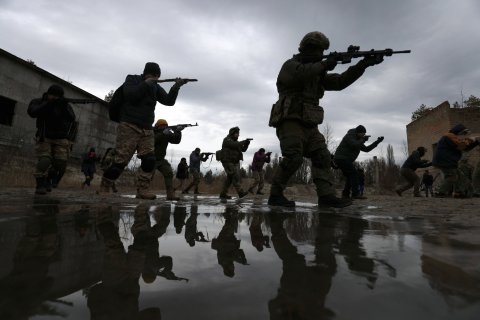
Despite repeated warnings that an invasion was imminent, many Ukrainians were shocked by the arrival of Russian troops. Here, members of Ukraine's Territorial Defense Forces participate in a drill days before the bombings began. Ethan Swope/Bloomberg/Getty
 

In an instant, Russian President Putin's invasion of Ukraine destroyed the post Cold War security order in Europe—one centered, to Russia's fury, by an often-expanding NATO alliance. Analysts expect that, once Kyiv falls, the military aggression will give way to a political settlement that puts a Russia-friendly government in place. By February 25, Ukrainian President Volodymyr Zelensky was considering an invitation from Moscow to hold "neutrality" talks in neighboring Belarus. If those talks happen, Putin will then be able to pull back troops and end the conflict—while having dealt the West a humiliating blow.

And that, military and Russia experts agree, may be the real point.

Ukraine, of course, is not a NATO member; the possibility that it might join the Alliance some day, as other countries that were once part of the old Soviet bloc have done, is a key issue in the current conflict. Putin's actions, a brazen defiance in the face of repeated warnings and threats of sanctions from U.S. President Joe Biden and western allies, now make it a certainty, if it wasn't before, that membership will never happen. Putin's aggression will also serve as a stark warning to countries formerly part of the Soviet Union of the possible repercussions of getting too cozy with the West.

The post Soviet status quo in Eastern Europe was one "that [Putin] never accepted," says Fyodor Lukyanov, editor in chief of Russia in Global Affairs, a Moscow-based foreign policy journal. "It ate at him. He believes Russia was treated [by the West] as a second class citizen after the Soviet Union fell."


Now, western diplomats and intelligence officials believe, Putin seeks to decapitate the western-leaning leadership in Kyiv headed by Zelensky and replace it with a government that will be loyal to "the new Tsar," as former Estonian President Toomas Ilves calls Putin. That could happen, U.S. intelligence officials tell Newsweek, within days. Putin does not want, nor does he need, to occupy the entire country to accomplish his greater goals, intelligence analysts and officials say. As Ilves puts it, "He wants a puppet state like Belarus," another former Soviet province just north of Ukraine, and from which troops poured into Ukraine as the Russian bombing ramped up. With a new reality on the ground in Eastern Europe, Ilves continues, "Putin then wants to rewrite the security rules of the road between him and NATO."

Ukraine itself appears to share at least part of that view. A statement from Mykhailo Podolyak, an adviser to Ukraine's presidential chief of staff, and shared with Newsweek by Ukraine's embassy in Washington, outlined what Kyiv suspected were Moscow's goals. "The Office of the President of Ukraine believes the Russian federation has two tactical goals—to seize territories and attack the legitimate political leadership of Ukraine in order to spread chaos and [to] install a marionette government that would sign a peace deal on bilateral relations with Russia," Podolyak said.

FE Putin's Endgame 07
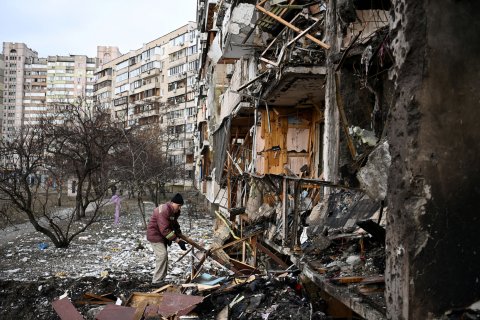
A man clears debris at a damaged residential building at Koshytsa Street, a suburb of the Ukrainian capital Kyiv, where a military shell allegedly hit, on February 25, 2022. Daniel Leal/AFP/Getty 

A United States that thought it was pivoting to Asia, and focusing on China—a country that is its preeminent rival going forward—has now been dragged back to Eastern Europe, where for centuries so much blood has been spilled. Putin now has the world's full, undivided attention, in the same way that every Secretary General in the Soviet era did. In chilling televised remarks after the invasion had begun, Putin said, "whoever tries to interfere [in Ukraine] should know that Russia's response will be immediate, and will lead to such consequences that you have never experienced in your history."

Russia is now back in the limelight, a nation that is demonstrating, with a display of military might, that it remains a Great Power. Which is precisely where Putin wants his nation to be. He believes Russia should at all times command respect from the rest of the world, "and when it doesn't command respect, it should command fear," as Lukyanov of Russia in Global Affairs puts it.

Mission accomplished. As Rose Gottemoeller, former deputy secretary general of NATO and a long time Russia watcher characterized it recently on the CBS podcast Intelligence Matters, "This is [Putin's] 'look at me' moment."

The West Responds

Within hours of the invasion, the United States and its allies responded by sharply ratcheting up economic sanctions but it's unclear whether the moves will deter the Russian leader. In a speech announcing the response, Biden said more than half of the West's high tech exports to Russia would be slashed, "degrading their industrial capacity," and hurting industries like aerospace and shipbuilding. He's also freezing the U.S. assets of four additional Russian banks, including VTB, the country's second largest financial institution, whose CEO is very close to Putin. "This is going to impose severe costs on the Russian economy, both immediately and over time," Biden said.

FE Putin's Endgame 06
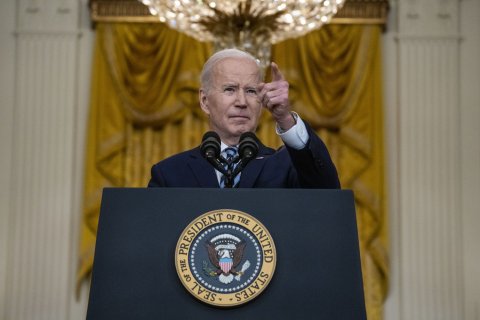
President Joe Biden takes questions after giving an update on the Russian invasion of Ukraine on Thursday, Feb. 24 in Washington, D.C. Kent Nishimura/Los Angeles Times/Getty
 

The following day, the White House announced it would join the European Union in implementing sanctions against Putin personally. The Russian President is widely thought to be one of the world's richest men, allegedly hiding much of his wealth in shell companies in various tax havens throughout the world.

How effective the sanctions will be is unclear. Putin, for his part, believes he has effectively made his country sanctions-proof. Russia has over $630 billion in hard currency reserves, and rakes in $14 billion per month in oil and gas exports. As Russia's ambassador to Sweden, Viktor Tatarintsev, told Swedish newspaper Aftonbladet days before the invasion began, when the West ramped up threats of financial penalties in a futile effort to prevent military action, "Excuse my language, but we don't give a shit about your sanctions."

Biden, in his remarks the day the invasion began, said he believes Putin may have brought himself a world of trouble by invading Ukraine. "History has shown time and again how swift gains in territory give way to grinding occupation, acts of mass civil disobedience and strategic dead ends," he said. And in fact, thousands of Ukrainian civilians have been training as part of newly formed "territorial defense organizations" set up in order to resist the Russians.

But U.S. intelligence officials privately do not share Biden's optimism about "mass disobedience." One official who spoke to Newsweek on background because he is not authorized to speak on the record said, "After the government in Kyiv is dismantled, there will be no opposition within Ukraine for us to support militarily."

His pessimism is rooted in Putin's past behavior, most notably when he presided over a scorched earth campaign to brutally put down an insurgency in Chechnya more than 20 years ago. He says, "It's not realistic to mount an opposition campaign. [Putin] does not value human life the same way that the free world does, hence [Russian troops] will eradicate any opposition en masse."

Indeed, Putin's history as a commander in chief of Russia's military shows that there may be reason to doubt Biden's optimism that Ukraine will turn into a quagmire for Moscow. Beyond the ruthless campaign to put down Muslim rebels in Chechnya, he hived off the two sections of the former Soviet state of Georgia that he wanted to control in 2008. Then in 2014 he took back Crimea in Ukraine, and set up separatist movements in two heavily Russian provinces in the east, Donetsk and Luhansk. (The day before the February 24th invasion, Putin declared those two provinces were now "independent republics." )

FE Putin's Endgame 08
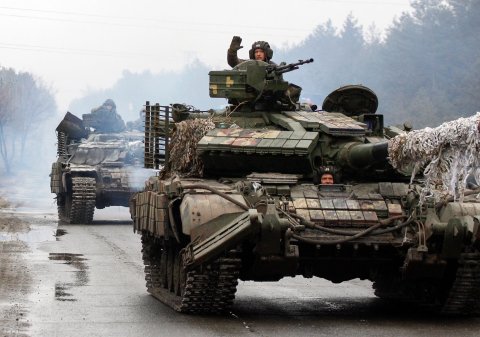
Ukrainian servicemen ride on tanks towards the front line with Russian forces in the Lugansk region of Ukraine on February 25, 2022. Anatolii Stepanov/AFP/Getty 

And on the complex battlefield in Syria, where the U.S. and Russians risked conflict, former President Barack Obama funded opposition rebel groups, including some tied to Al Qaeda, then failed to enforce his own red line after President Basar Al Assad used poison gas on his enemies. Putin sent Russian troops in with one goal: that Assad maintain his grip on power. He remains in office to this day.

The Ultimate Goal

What is Putin's endgame now? The Russian leader is fueled by rage and seeks revenge against the West for his homeland's perceived mistreatment, says Peter Rough, a senior fellow at the Hudson Institute, a conservative think tank based in Washington. The country Putin grew up in, and the one he served as a KGB officer, dissolved in 1991. In its stead came chaos at home, and, in Putin's view, betrayal from abroad.

The demise of the Soviet Union, he has famously said, "was the most catastrophic geopolitical event of the 20th century" (worse, even, than World War II, in which 20 million Soviet citizens were killed). His resentment over what happened to his country, particularly in the immediate aftermath of the Soviet collapse, is more widely shared by Russians than many in the West appreciate.

As the Moscow bureau chief for this magazine in the early 2000s, I saw organized crime take over businesses large and small; the country's finances were in shambles. The government was unable to pay the salaries of a once proud military. I interviewed an Army colonel stationed on the Kamchatka Peninsula, in Russia's far east, who wept as he confessed he wasn't able to buy his wife a birthday present a few weeks earlier because he had not been paid his wages in months.

Boris Yeltsin, once the democratic hero who helped bring down the Soviet Union, had turned into a drunken mess as the first freely elected president of Russia; his inner circle was corrupt, enriching themselves as ordinary citizens struggled amidst the post Soviet chaos. On New Year's Day, at the dawn of the new millennium, Yeltsin stepped down. He was replaced by the man he had named Prime Minister months earlier, Vladimir Putin.

Twenty-two years later, in an extraordinary 55-minute speech to his country on Monday February 21, Putin aired many of his grievances in a way he rarely had publicly before, as a prelude to war. In it, he said, "Ukraine is not a separate country," and that "Ukrainians and Russians were brethren, one and the same." Kyiv, in his view, had been ripped unceremoniously from Mother Russia when the Soviet Union dissolved. He then recounted the West's early promise not to expand NATO.

He recalled how coldly then President Bill Clinton responded to his query, not long after he became President of Russia in 2000, about whether Moscow could ever be a member of NATO. He recalled, bitterly, how he was assured that NATO's expansion eastward—to include countries that had been members of the Warsaw Pact, Moscow's former client states—would "only improve their relations with us, even create a belt of states friendly to Russia.

Everything," Putin said, "turned out exactly the opposite. They were just words."

FE Putin's Endgame 09
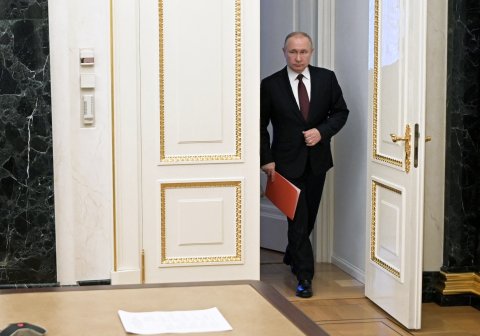
Russian President Vladimir Putin arrives to chair a Security Council meeting via a video link in Moscow on February 25, 2022. AlexeyNikolsky/AFP/Getty 

How does Putin seek revenge for this betrayal? To the extent he can, he wants to piece together a new Russian Empire. Not necessarily every province of the former Soviet Union, but those parts of the pre-Soviet empire, established by the Tsars, who were largely Russian speaking, orthodox Christian and who looked first to Kyiv, and then later to Moscow, as the political, cultural and spiritual center of the world.

Putin is a nationalist first and foremost. Ukraine, plainly, is central to this vision. But it also includes the countries—former Soviet provinces—that are now effectively Russian client states (Belarus), as well as those Moscow wishes to control yet again: the Baltic states of Lithuania, Estonia and Latvia (the latter three are now members of NATO, for whom the alliance is obligated to fight in the event one of them is attacked.) Putin in his pre-invasion speech said it was "madness" that the Baltics were ever allowed to leave the USSR. He has demanded—preposterously—that the Alliance pull back to its 1997 stance, when there were just 16 members, as opposed to 30 today.

Point, Counterpoint

It is for that reason that Biden is moving more NATO troops and materiel into the Baltics. On February 25, NATO Secretary General Jens Stoltenberg said the Alliance would for the first time dispatch troops from the Spearhead Unit of its so-called Response Force—formed in 2014—to member states along the eastern front. NATO describes the Response Force as ''highly ready and technologically advanced." It consists of 40,000 troops from a variety of NATO countries. Stoltenberg declined to say precisely how many troops would be deployed now.

More deployments are likely in the months ahead. President Biden vowed in no uncertain terms that an attack on a NATO member would trigger Article 5, the provision that maintains any armed attack against one country in the Alliance is considered an attack against all. If Putin moves on the Baltics, or on any NATO members who formerly were part of the Warsaw Pact—like Poland, Romania or Bulgaria, all of which border Ukraine—then Moscow will be at war with NATO.

With the invasion of Ukraine, analysts believe, Putin hoped to shake NATO. He wanted, says Douglas Wise, a former CIA officer and deputy director at the Defense Intelligence Agency, "to further divide our allies, and cement existing fissures and disunity within [the Alliance] and the EU. He also believes he can benefit by humiliating the Western leaders and institutions when they fail to develop credible and practical options to counter his aggression."

Whether Putin benefits at home for his audacious attack on Ukraine is not yet clear. (There were small protests in major Russian cities in the immediate aftermath of the invasion.) But if creating more stress on NATO was one of his goals, that failed.

FE Putin's Endgame 05
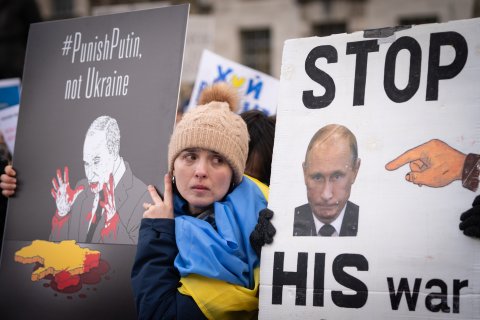
Ukrainians hold a protest against the Russian invasion of Ukraine outside Downing Street, central London. Stefan Rousseau/Getty
 

The Germans were widely viewed as the weakest link when it came to Russia, because of the two countries' significant trade ties. And at the outset of the crisis, that skepticism seemed justified. Early on, for example, Estonia wanted to send a batch of old howitizers in its possession to Kyiv. But NATO regulations say that any weaponry given or sold to a non-NATO member must be approved by the country of origin. In this case, that country did not exist: The howitzers had been in possession of the old East Germany. Upon unification, Germany took control of them and ultimately passed them on to Finland, who eventually gave them to Estonia. When Tallinn wanted to send them on to Ukraine, to do its bit to help shore up Kyiv's defenses, Germany—astonishingly—declined to approve the transfer.

That was followed by Berlin's deep reluctance to stop the Nord Stream 2 natural gas pipeline linking Germany and Russia, despite pressure to do so from its own ambassador to the U.S., Emily Haber. Following the refusal, Haber wrote a widely publicized cable to new Chancellor Olaf Scholz, saying that the country was gaining a reputation as a bad ally.

To Putin, this must have indicated that his gas-politik was paying huge dividends. But it didn't last long. Scholz visited Washington in early February and, in a post meeting press conference with Biden, stood by meekly as the president asserted that Nord Stream 2 was dead if Moscow took military action against Ukraine. On cue, hours after the invasion began last month, Germany halted certification of the $11 billion project.

In fact, far from deepening fissures within the alliance, Putin's Ukraine gambit has had the opposite effect. Former CIA Director and Army General David Petraeus, upon returning from the Munich Security Conference shortly before the invasion, said he had never seen the Alliance so unified since the days when he served at NATO headquarters during the Cold War.

The evident unity among the members of what Biden accurately called the most powerful military alliance in history, has only made the plight of Ukraine more poignant. As the invasion unfolded, a member of the Ukrainian parliament in Kyiv, Alexey Goncharenko, begged NATO to impose a no-fly zone, to allow his countrymen to have a fairer fight on the ground. There was zero chance of that happening, because Kyiv wasn't in the club.

FE Putin's Endgame 10
Ukrainians flock to the train station to leave capital Kyiv after Russian military intervention in the country in Kyiv, Ukraine on February 25, 2022. Wolfgang Schwan/Anadolu Agency/Getty
 

Soon now, its desire to be part of the West will be moot, as Putin's Russia takes control—little more than 24 hours after the invasion began, Russian forces were already entering the the capital and Kyiv was hit with Russian "cruise or ballistic missiles." Success is inevitable because Biden and the allies have made it clear that Moscow will not meet military resistance from the West. Over and over Biden has told the American people the U.S. will not fight on the ground in Ukraine. He knows the public has no stomach for it.

If events play out as military analysts now expect, the conflict will end relatively quickly with a negotiated settlement that may cede some territory to Russia, the installation of a new Russia-friendly regime in Kyiv and a partial withdrawal of troops that allows Putin to avoid the quagmire the West so badly wants him sucked into. In doing so, Putin will be able to claim that he dealt a devastating setback to NATO, the main goal of his aggression.

For Putin, the sack of Ukraine will likely mark the endgame in his desire to restore the empire. If it doesn't, it will mean at some point the world's two largest nuclear powers will be in a shooting war, with all the risk that entails. With his words and more importantly his actions, Biden is frantically signaling to Putin: this far, but no further. An anxious world hopes the Russian leader, satisfied with victory in Ukraine, will get the message.

Tuesday, February 22, 2022

America's Ruling Regime Doesn't Fear Disinformation. It Fears Truth

 America's Ruling Regime Doesn't Fear Disinformation. It Fears Truth


Democrats Plan Witch-Hunt To Destroy Republican Party, Leaving the U.S. A One-Party Dictatorship

The Biden/Democrat Hunt For "Domestic Terrorists" and the Coming "Internet Purge"

Biden Names Obama's Top Behaviorist Brainwasher To Wage War Against Americans With Criminal Thoughts

Electing Biden Means War with Russia...period.

America's Ruling Regime Doesn't Fear Disinformation. It Fears Truth | Opinion


In Joe Biden's America, attempting to cancel Joe Rogan is just counter-terror policy.

This is because our ruling class—in the name of "defending democracy"—classifies those who question the regime on any matter of consequence as a threat to the homeland, and pledges to pursue them accordingly.

Our ruling elites have engaged in an overt war on wrongthink masquerading as a domestic counter-terror mission since at least January 6, 2021.

As part of this effort, the Department of Homeland Security (DHS) recently issued a speech-chilling National Terrorism Advisory System Bulletin. It claims the United States is in a "heightened threat environment fueled by several factors, including an online environment filled with false or misleading narratives and conspiracy theories, and other forms of mis- dis- and mal-information."


It would appear the Biden administration considers the ivermectin-hocking, tequila-swigging, Bernie Sanders-supporting Rogan to be public enemy number one on this issue.

Shortly after hosting dissenters from COVID orthodoxy including Drs. Peter McCullough and the then-recently deplatformed Robert Malone on his podcast, Rogan found himself the subject of a cancel campaign contrived by washed-up musicians, non-medical doctors and corporate media whose ratings he has crushed.

But it wasn't just these parties out for blood.


This effort was, to put it mildly, disingenuous. We know how seriously to take the administration's views on COVID "misinformation and disinformation" because by its own standards the White House, and its media mouthpieces, have been the most powerful and prolific purveyors of "misinformation."

The administration has flip-flopped on virtually every aspect of the coronavirus to positions that its social media adjuncts used to ban people over. It did so not because "the science" has changed, but because the politics have changed.

Biden's White House says its critics are dangerous—not to the public, but to its rule, as if that rule is equivalent to America or democracy itself, as Dr. Anthony Fauci is to science.

As the DHS bulletin notes, the first key driver of the "heightened threat environment" is the "proliferation of false or misleading narratives, which sow discord or undermine public trust in U.S. government institutions."

Never mind what those government institutions themselves have done to sow discord or undermine public trust, like, say, calling for Twitter and Facebook to censor people.

It's the critics, the dissenters—those with no monopoly on force or multi-trillion-dollar budgets—who are the real scourge.

The bulletin lists as another potential threat "false or misleading narratives regarding unsubstantiated widespread election fraud"—perpetuating the narrative of "insurrection" so central to the effort to persecute wrongthinkers, while eliding that Democrats' own election integrity-eroding measures destroyed confidence in the system.

Joe Rogan podcast
This illustration photo shows the Spotify page for "The Joe Rogan Experience" podcast displayed on a smart phone in Washington, DC on February 7, 2022. - The head of music streaming giant Spotify Daniel Ek has condemned podcaster Joe Rogan's use of a racial slur but insisted that silencing him was not the answer. MANDEL NGAN / AFP/Getty Images 

Previous Biden-era bulletins similarly focused on COVID-19 and election integrity, but the latest one—in a new twist—also claims that calls for violence have been tied to anger over "the evacuation and resettlement of Afghan nationals following the U.S. military withdrawal from Afghanistan."

So it's not just questioning the merits of mask and vaccine mandates, or skepticism over the security of mass mail-in elections, but doubts about the wisdom of dropping unvetted refugees from a terror-dominated backwater into the middle of your town that could get you in trouble with the security state.

This threat bulletin, like its no less disturbing predecessors, flows naturally from the Biden administration's first-of-its-kind National Strategy for Countering Domestic Terrorism.

That strategy calls for confronting long-term contributors to domestic terrorism, including:

enhancing faith in government and addressing the extreme polarization, fueled by a crisis of disinformation and misinformation.... We will work toward finding ways to counter the influence and impact of dangerous conspiracy theories that can provide a gateway to terrorist violence.

Linking speech that does not comport with regime orthodoxy to terror, and using that pretext to police thought—with an armed Ministry of Truth operating out of our national security and law enforcement apparatus—therefore manifestly is "counter-terror" policy.

Casting critics as terrorists and threatening to sic the most powerful, pervasive and sophisticated security state in the history of the world on them is of course not about defending democracy or protecting the truth, but intimidating democratic opposition into silence and submission to an official narrative.

The regime evidently believes it must maintain a monopoly over the American mind to maintain a monopoly on power.


Joe Rogan threatened that power, and therefore constituted a danger. The threat was that he elicited insights from guests who challenged the regime's credibility on all manner of issues related to COVID, and millions of people heard it.

Trump and his allies likewise threatened that power, and therefore constituted a danger. They were—and continue to be—pursued like terrorists, as the House January 6 Committee wields the full force of the federal government to investigate them, surveil their communications and audit their dealings. Why? Trump and his allies called the regime a failure, stated undeniable truths that resonated with Americans to justify that view and supported policies aimed at rectifying said failures that would disempower the ruling elites.

The most meek and unthreatening of January 6 defendants now face extreme, hyper-political prosecutions. They are being made an example of not because they ever posed a credible threat to the regime's power, but as a signal to the millions of peaceful, patriotic Americans who might—through their collective speech, advocacy and voting.

The same goes for the parents outraged over anti-scientific and detrimental COVID-19 policies, and over critical race theory indoctrination in schools. The Department of Justice threatened to pursue them like jihadists—not because they are jihadists, but because parents awakened to the regime's corrupt monopoly on the all-important institution of education could break that monopoly and end the careers of the politicians who support it. They must therefore be chilled.

The war on wrongthink is not about left or right. It's about who rules: a sovereign people or the elites who deign to lord over us.

The ruling class—the "defenders of democracy"—sees citizens on the left and right opposed to its agenda and refuses to address their concerns peaceably. Instead, it calls them terror threats and pursues them using the full power of the public and like-minded private sectors.

The ruling class does not fear misinformation and disinformation. It fears truth, particularly the truth about its own rot, corruption and incompetence, which calls into question its authority.

This leaves us with a question: when everyone, from unorthodox presidents to curious podcasters to caring parents are deemed existential threats to the regime, how strong is the regime?


Ben Weingarten is a senior fellow at the London Center for Policy Research, fellow at the Claremont Institute and senior contributor to The Federalist. He is the author of American Ingrate: Ilhan Omar and the Progressive-Islamist Takeover of the Democratic Party (Bombardier, 2020). Ben is the founder and CEO of ChangeUp Media LLC, a media consulting and production company. Subscribe to his newsletter at bit.ly/bhwnews, and follow him on Twitter: @bhweingarten.

Wednesday, February 16, 2022

The Treasonous Campaign To Overthrow the American President By Hillary and Obama

 The Treasonous Campaign To Overthrow the American President By Hillary and Obama


Exposing The Clinton/Obama Scheme To Wage Political War On Donald Trump

“Bipartisan” Washington Insiders Reveal Their Plan for Chaos if Trump Wins the Election

The Coming Coup?
Democrats are laying the groundwork for revolution right in front of our eyes.

Obama lawyers form 'worst-case scenario' group to tackle Trump

Obama...Sore Loser, Wants Old Job Back...Hires Civilian Army To Sabotage Trump

Adriana Cohen: Donna Brazile, Liz Warren say DNC, Hillary Clinton worked to sabotage Bernie Sanders Hillary Clinton says Biden should not concede the election 'under any circumstances'

Russiagate, the collective delusion that Donald Trump was secretly a Russian agent aided and abetted by the Kremlin, the topic of uncountable inches of Washington Post and New York Times copy and the entire primetime lineup of MSNBC, was a dirty trick by the Hillary Clinton campaign. Not just part of it. All of it. One of the most diabolical, successful misinformation campaigns ever concocted.

We already knew that the Steele dossier was garbage. Christopher Steele was paid indirectly by the Clinton campaign to dig up dirt, which he did by turning to other Clinton operatives, laundering every outlandish rumor about Trump he could find into an “investigative” document.

He shopped it to the FBI, which couldn’t verify his sources or any of his stories, but the agency dragged out the investigation to cast maximum suspicion on the new president. In the meantime, Steele found willing accomplices in the media to push his propaganda. The dupes at BuzzFeed even decided to print the whole pack of lies, with the flimsy rationale of “Well, why not?”

Hillary Clinton
Democrats are calling for Clinton to be investigated for her role in Russiagate.
Masterclass via REUTERS
Former President Donald Trump holds up papers as he speaks about the coronavirus in the James Brady Press Briefing Room.
President Donald Trump holds up papers as he speaks about the coronavirus in the James Brady Press Briefing Room.
Alex Brandon/AP

We got to the point where New York magazine was running a cover story that was one long piece of fan fiction that Trump was secretly a real-life version of “The Americans,” a sleeper agent now seated in the highest office in the land. The Times and Washington Post won a freaking Pulitzer!

A made-up story

Now another piece of Russia, Russia, Russia is kaputski. A computer server operated by Trump’s company was secretly communicating with a Russian firm, claimed Slate magazine and endless Twitter threads of would-be tech experts.

But as special counsel John Durham outlines in his latest indictment, that was just a story made up by tech executive Rodney Joffe, who desperately wanted a job with the Clinton administration. He hacked Trump’s servers, cherry-picked privileged Internet data he had access to, and molded it to look like something nefarious.

John Durham
Recent Durham filings have shown that Trump’s suspicion that he was being spied on was true.
Bob Child/AP

He was coached by lawyer Michael Sussmann — who was being paid by the Clinton administration, although he lied about that to investigators. Sussmann goes to the FBI as a “concerned citizen” — not a “Clinton stooge” — to try to get them to bite. The ultimate goal: Be able to leak to the Times that Trump is under official investigation.

Durham “definitely showed that the Hillary Clinton campaign directly funded and ordered its lawyers at Perkins Coie to orchestrate a criminal enterprise to fabricate a connection between President Trump and Russia,” says Kash Patel, the former chief investigator for the House Intelligence Committee.

Beyond outrageous

Of course, Hillary didn’t get what she wanted — the presidency. But her operatives didn’t stop, going on CNN to give “very concerned” interviews about a theory they knew was bull. All to undermine Trump’s presidency. It would take three years for the Mueller report to finally put the lie to rest, and we’re now, five years out, at the point where Durham is detailing the full conspiracy.

If this had happened to a Democrat, the press would be losing its mind. A candidate for president weaponized the nation’s Justice Department to pursue an investigation into their political opponent based on what they knew were lies. Americans were wiretapped! Some were entrapped for flimsy claims of perjury. The director of the FBI went into the Oval Office to tell the president that there was a sexual rumor floating around, so that it could be promptly leaked to the media. “Outrageous” doesn’t cover it. And still no shame from Hillary Clinton and her supporters, because it’s Donald Trump — anything is fair game to take him down.

All these things we’ve been lectured about over the past four years: Norms being broken, internet misinformation, perversion of government — it was all happening. It was the Democrats who were doing it. Think anyone in the left-wing media will notice?

Monday, August 30, 2021

ISIS-K Is Just Another Product of CIA Afghan Assassin Network

 ISIS-K Is Just Another Product of CIA Afghan Assassin Network

[ISIS-K consists of mercenary "Islamists", mostly ex-TTP, who have been hired by ISIS in Syria to create the impression of a growing worldwide "Caliphate". Originally recruited from anti-Shiite/Hazara mass-murderers in Pakistan and Afghanistan, to come to Syria and continue their work there. After being run-out of Pakistan by Pak Zarb-i-Azb military offensive, the TTP, soon to be ISIS-K, were sheltered for several years in Afghanistan by local Pushtuns and the Afghan secret services until they became useful. The Afghan Govt supported a Khorasani offensive against the Afghan Taliban, until they were severely beaten by the Talib and thereafter kept penned-up in and around Nangarhar (Afghan Taliban Keep ISIS Penned-Up In The Wilderness of Nangarhar https://therearenosunglasses.wordpress.com/2016/11/27/afghan-taliban-keep-isis-penned-up-in-the-wilderness-of-nangarhar/). After the Taliban victory, Taliban found them useful, using them to attack the Americans and the airport, making new American media disinformation (Trusting the Taliban to Fight Islamic State https://www.bloomberg.com/opinion/articles/2021-08-27/the-u-s-may-be-relying-on-the-taliban-to-fight-islamic-state-bad-move) seem probable, allowing the CIA to continue and to expand Afghan operations under the watchful Taliban eye.  https://www.foxnews.com/world/kabul-explosion-signals-opening-of-jihadi-civil-war-in-afghanistan[

TTP Spokesman Confesses the Expected...Pak. Taliban Work For India, Afghanistan

The Islamic State in ‘Khorasan’: How it began and where it stands now in Nangarhar

Top US Gen. Admits That 70% of "ISIS" In Afghanistan Actually TTP, Pakistani Taliban

The top US commander in Afghanistan General John Nicholson has said roughly 70 per cent of the Islamic State of Iraq and Syria (ISIS) terror group loyalists fighting in Afghanistan are the members of Tehrik-e-Taliban Pakistan.

“In the case of Islamic State Khorasan province, the majority of the members are from the Tehreek-i-Taliban Pakistan (TTP).”

https://www.foxnews.com/opinion/tucker-carlson-talibans-job-easier-biden-list-americans-afghanistan

https://www.bloomberg.com/opinion/articles/2021-08-27/the-u-s-may-be-relying-on-the-taliban-to-fight-islamic-state-bad-move

Afghan Taliban Keep ISIS Penned-Up In The Wilderness of Nangarhar

United States Re-Packaged Al Qaeda As ‘Khorasan Group’ To Sell Attack (On Syria)

US Drone Strike In Khost Kills 3 TTP/ISIS Taliban, While Pak Army Hangs 2 More, Same Group

Manufacturing Justification for the NATO Takeover of Central Asia--(Part One)

Smashing Greater Central Asia—Part II  Risking the World

Smashing Greater Central Asia—Part III  Phantom Threats

Smashing Greater Central Asia – (Part IV)--Smashing Systematically


Kabul explosion signals opening of jihadi civil war in Afghanistan

Former State Department member says ISIS-K ‘tends to be about as far on the spectrum of evil as you can possibly be.’

 
A former member of the U.S. State Department said the real purpose of Thursday's suicide attack in Kabul, which killed 13 U.S. service members and scores of Afghans, was "an opening salvo of a civil war ISIS-K is seeking to fight against the Taliban."

The ISIS-K suicide bombing marked the deadliest day for American forces in Afghanistan since August 2011.

In an interview with Fox News, Christopher Harnisch, former deputy coordinator for counterterrorism at the U.S. State Department, broke down the terrorist group’s motivation for the attack amid the U.S. completing its withdrawal from the country.

"We in the West tend to think of the target being Americans," Harnisch told Fox News. "The real purpose was to attract potential recruits into its ranks, and also to really launch a civil war against the Taliban and other groups fighting along the periphery."
The group, known as Islamic State Khorasan Province or ISIS-K, is an Afghan affiliate of the group's core leadership in Syria and Iraq. After the Islamic State lost its territory following a five-year military campaign by local and international forces, the caliphate increasingly turned to Afghanistan for its fighters.

ISIS-K was founded in 2015 by several hundred disillusioned Pakistani Taliban fighters. According to Harnisch, the goal of all ISIS factions is "to establish a global caliphate governed by the most extreme and oppressive interpretation of Sharia."

"With the withdrawal from Afghanistan, ISIS-K sees an opportunity to fill a security vacuum and ultimately try to come to power," he continued.

In order to gain control of the region, ISIS-K will have to fight the Taliban, which just toppled the U.S.-backed government in Afghanistan after a 10-day blitz and currently sits at the helm of the country.

In addition to sparking a civil war with rival militant Islamist jihadi groups, another reason for the attack was to aid the terrorists group's global recruitment effort.

"ISIS-K knows that in order to achieve success and achieve its vision of setting up a caliphate based in Afghanistan, it's going to need manpower," said Harnisch.

A United Nations report in June found that 8,000 to 10,000 jihadists from Central Asia, the North Caucasus region of Russia, Pakistan and the Xinjiang region in China have entered into Afghanistan in recent months. According to the report, most are associated with the Taliban or Al Qaeda, the report said, but others are allied with ISIS-K.

"ISIS-K’s objective was to undermine the credibility of the Taliban by showing Afghans and the world that the Taliban is incapable of providing security," Harnisch claimed. "The attack was a huge propaganda victory," he continued.  "Aspiring jihadists all over the world saw that and they're saying, ‘ISIS is the one in charge here.’"

While ISIS-K’s estimated 1,500-2,000 members pale in comparison to the Taliban’s near 80,000, Harnisch said he believes the number of ISIS-K recruits entering into Afghanistan will increase over the coming months following Thursday’s attack.

When comparing ISIS-K with the Taliban and Al Qaeda, Harnisch said "tactically speaking they're very similar," with all three engaging in "absolutely barbaric, evil terrorist attacks."

However, he admitted that ISIS-K’s attacks "tend to be about as far on the spectrum of evil as you can possibly be."

Harnisch specifically recalled an incident in 2020 in which ISIS-K targeted the maternity ward of a hospital in Kabul, killing 24 people including newborn babies and mothers.

"The Taliban and al-Qaida, though evil organizations and barbaric in their own right, haven't gone that far in terms of their attacks," he said.

Despite the Unites States’ desire to disengage from long, drawn-out international conflicts, Harnisch claimed, "the fight against terror, it will continue."

The former Counterterrorism Director at the National Security Council criticized .U.S leadership for its false promise to "end forever wars."

"We ended the war in Afghanistan, but I can tell you right now that the war against terror is not over," he said. "It will continue because we just handed the Taliban, ISIS and al Qaeda, a major victory."


peter.chamberlin@hotmail.com

Saturday, August 21, 2021

Taliban Didn't Win in Afghanistan, the Defense Contractors Did


Taliban Didn't Win in Afghanistan, the Defense Contractors Did | Opinion


You've probably read a lot about Afghanistan in the past week, more perhaps than at any time in recent memory. There are any number of hot takes, articles, op-eds and analyses of the Taliban, the U.S. withdrawal and the geopolitical implications of the fall of Kabul. These are all very valuable topics that are worth discussing. But what is curiously missing from much of the conversation is how this failed war had been extensively outsourced to nontransparent and unaccountable actors.

A purported war for a democratic Afghanistan pursued in glaringly undemocratic ways.

It behooves America to consider how and why so much of such a vital conflict was assigned to private contractors—and whether that kind of approach was even partly to blame for the debacle that ensued. It might be. That is not even to broach the topic of whether so much of the world's most powerful country's foreign policy should be in the hands of corporations that do not answer to the people footing the bill, namely, the taxpayer. I would have expected more Americans to be outraged.

Perhaps, one can hope, that outrage will swell over time, as more Americans come to learn of what exactly transpired—and how much of their treasure was squandered. I must insist journalists do their part to follow the money. We cannot let this story slip from the headlines without demanding accountability. Even a cursory examination of what happened would provoke great consternation—revealing, at times, a grim and tragic comedy of errors.

Afghanistan is an unforgiving and mountainous country. One reason perhaps it is called "the graveyard of empires." A whopping 1 percent of the country is thickly forested, which makes the decision of a singular Afghan official—as I detail in my recent book, The Broken Contract—to demand forest camouflage uniforms for the Afghan National Army to be absurd. Nevertheless, each American paid about $.25, for a total $28 million for these marginally useful uniforms.

Perhaps the camouflage did some good, though—after all, the Afghan National Army all but disappeared from view in a very short span of time.

The deeper we dig, the more upsetting the numbers and corruption get. The Special Inspector General for Afghanistan Reconstruction (SIGAR) found that, in 2018, some $15 billion dollars of government funds were wasted, used fraudulently, or otherwise abused. A further $8 billion was spent on buildings and vehicles since 2008. Astoundingly, less than 10 percent of that outlay was in good condition, although of course that may be a blessing in disguise, given said military's collapse.

Otherwise, the Taliban would have still more American weapons and supplies on hand. Weapons and supplies that will be used to suppress the Afghan people. We can be thankful that some brave Afghan pilots flew their aircraft out of the country, preventing some of that advanced weaponry from falling into the hands of the Taliban. Of course, not all the aircraft made it out, and who's to say the Islamic Emirate of Afghanistan won't trade that technology to American rivals in exchange for aid and investment?

It happened before, after all, when the Chinese got their hands on an American aircraft that had crashed during the Abbottabad raid that killed Osama bin Laden.

All of these numbers, added together, total around $83 billion, which is the amount of money that went to build up the capability of the Afghan National Army. There is another still more eye-popping amount that should be considered. It is estimated that America spent close to $2 trillion over the course of the entire Afghanistan war, to say nothing of the many Americans who lost their lives, the many more who are seriously injured and the even more who are traumatized.

An Afghan armed man
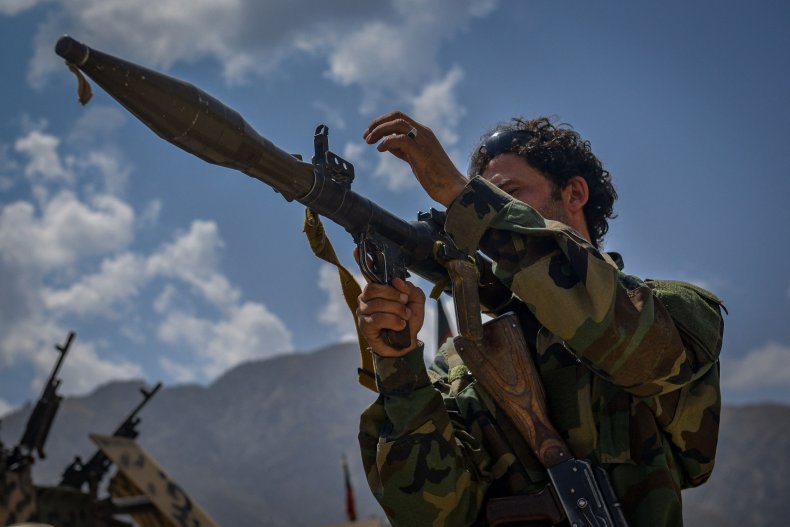
An armed man supporting the Afghan security forces against the Taliban pictured with weapons at Parakh area in Bazarak, Panjshir province on August 19, 2021. AHMAD SAHEL ARMAN/AFP via Getty Images

Could it be that a culture of outsourcing and a culture of contractors is partly to blame?

Consider that this spring there were still some 7,000 contractors in Afghanistan, helping to run its military and keep its Air Force in good order. Why, one wonders, would America build up a military it knew could not sustain itself if America's intention was to eventually hand power back to the Afghans? Could it be that war profiteers and their allies hoped to reap handsome profits from continuing non-governmental relationships even after the United States officially departed the country?

An Afghan National Army under severe pressure from the Taliban would be consistently desperate for ammunition and expertise, leading to a potentially wildly lucrative opportunity. Of course, we cannot know until we investigate further, even as this is in the immediate moment a theoretical exercise. The Afghan National Army has apparently disappeared. But shouldn't we ask why? Shouldn't we wonder what happened? Shouldn't we ask how this happened?

To know whether we should go to war in the future, and if circumstances demand that, how we should go to war as well. With the Taliban slipping back into their brutal patterns, it goes without saying that these questions receive greater urgency. At the very least, we should be heartened that the Taliban's manipulation and perversion of my religion are not inescapable. In the past, Afghanistan was a more liberal and tolerant place, which means it is possible to be that again.

We owe it to the Afghan people to understand whether our decisions made that future more likely or less likely.

Just as American citizens deserve transparency and honesty, so do the people of Afghanistan.

Dr. Saqib Qureshi is author of the Broken Contract: Making Our Democracies Efficient, Representative, and Accountable. He is an award-winning author, an expert in democratic policy development and has advised multiple governments. He is the CEO of the top Toronto-based real estate firm Building Capital, and previously worked at HSBC Investment Bank and McKinsey & Co. He has written for The Financial Times, The Wall Street Journal, HuffPost, Entrepreneur, Euronews and TRTWorld. In addition he is author of the award-winning book Reconstructing Strategy: Dancing with the God of Objectivity. He is currently a visiting fellow of the London School of Economics (LSE).

The views expressed in this article are the writer's own.

Mullah Baradar...central terrorist leader at the center of CIA/ISI Psyop, deception operation


Mullah Baradar... (click on Baradar, 106 posts)

central terrorist leader at the center of CIA/ISI Psyop, deception operation 
 

Arresting Taliban To Cover America’s Ass--(updated 1/29/19)

By:  Peter Chamberlin

The multitude of theories on the reasons for the arrests are divided between cooperation and confrontation theories, either it is explained by mutual interests or by rivalries.  In my opinion, it is both.

Researchers and analysts are banging their heads against many walls, searching for meaning in reports of multiple arrests of Taliban, by the Pakistani government.  Speculation is running rampant, that Pakistan has finally “seen the light,” that it represents a “split” within the Taliban, or that Pakistan has arrested Taliban who have been negotiating with Brits or Americans.  In my opinion, the arrests began as a clean-up operation to remove links to the intelligence being revealed in British courts, but it turned into a tit-for-tat series of paybacks between the ISI and the CIA.

The true meaning of the arrests can be ascertained from the timing of the events.  It may have been primarily an American/Pakistani operation to isolate Taliban leaders who had either negotiated with the British, or had been held at Guantanamo.  British courts had taken up the case of Binyam Mohamed and American officials publicly stated that disclosing classified information about US abuse of this detainee would damage intelligence cooperation between the agencies of the two nations.

The first arrest, of Taliban number two, Mullah Abdul Ghani Baradar, was on, or about  Feb. 7.  Multiple news reports have tied Baradar to ongoing negotiations to identify and isolate “reconcilable” Taliban.  These attempts at negotiating have all come from the British or Afghan sides, with the US supposedly prepared to take advantage of any breakthroughs.

On February 10, 2010:


A British court has ordered the government to disclose classified information about the treatment of a former Guantanamo Bay…It was released after judges at an appeals court on Wednesday rejected the UK government's claim that disclosing the information would damage intelligence co-operation with US agencies.”

In the days that followed, the western media was abuzz with more reports that Pakistan had made multiple “arrests” of the Taliban’s leadership.  It is impossible to know how many of these names obtained from the Western media are correct, but some of them had also been tied to the British negotiations, while at least two of them were former inmates of Guantanamo.

Mullah Abdul Raouf. GUANTANAMO Taliban military chief for northern Afghanistan

Mullah Abdul Qayoum Zakir GUANTANAMO around 2006, then transferred to Afghanistan government custody in late 2007, eventually released around May 2008. American officials won't say why he was let go and have not released a photograph of him.

Mullah Abdul Salam is unidentifiable, at this point, whether he is the governor of Kunduz, or the former Taliban who was involved with British diplomat Michael Semple and EU diplomat Mervyn Patterson, or still other candidates, such as former inmate of Guantanamo Mullah Abdul Salam Zaeef, or Mullah Abdul Salaam Rocketi.

Mullah Muhammad Hassan

Mullah Muhammad Younis.  who is also known as Akhunzada Popalzai

Mullah Ahmed Jan Akhunzada (could be Akhunzada Popalzai)

Maulavi Abdul Kabir, aka Mullah Abdul Kahir Osmani

Mohtasim Agha Jan, son-in-law of Mullah Omer


Do the arrests mean that Pakistan has embraced the American mission in the war on terror?

The following timetable relates the arrests to the rest of the unfolding understory.

1/28-  London conference

2/2-4-  India/Iran development conference, topic opening Afghan route

2/8-  Mullah Abdul Ghani Baradar

2/13-  Operation Moshtarak offensive begins

2/17-  Mullah Abdul Salam

2/18-  Car-bomb targeting Mangal Bagh mosque, blamed on Berelvi  “Ansar al-Islam”

2/18-  Mohammed Haqqani killed in Predator attack

2/20-  Two Sipah e-Sahaba militants killed Faisalbad

2/20-  Pak Army adds 26 posts to border, Balochistan

2/23-  Rigi arrested

2/23-  Pak announces new naval base near Gwadar

2/24-  Qari Zafar killed Predator

2/25-  India/Pakistan talks

2/26-  Kabul bomb targets Indian doctors

2/26-  Khalid Khwaja petitions Lahore High Court to block deportation of Taliban.

2/27-  Intra-Sunni battles Faisalbad  (revival of Sipah e-Sahaba attacks on Berelvi)

2/27-  Hafiz Saeed, “India will have to fight if it will not talk.”  Silence on Taliban arrests

If you look at the timetable to understand whether or not Pakistan and the US are on the same page you see some clear evidence of a joint US/Pakistan mission to eliminate the Taliban leadership, but more than that, you see specific acts of resistance on Pakistan’s part.

There is one inescapable reality--the Pakistani Army will never truly turn on the Taliban, who represent their last line of defense, as well as their first option, in any contest with India.  The historical relationship between the military and the militants has been one where the government has used sectarian terror groups (and even created them) to keep the tribes, sects and political groups in line.  Keep these things in mind, as you consider the events.

In addition to the arrests, the timetable details American predator strikes which have eliminated some of the Army’s protected militants, in particular, Mohammed Haqqani and Qari Zafar.  In between those two American assassinations, you have the arrest of American asset against Iran, Abdolmalek Rigi, thanks to Pakistan’s ISI.  Between the Haqqani hit and the Rigi arrest, Pakistan set-up 26 border posts to block US hot pursuit into Balochistan.  Long dormant Sipah e-Sahaba started anti-Berelvi rioting in Faisalbad.  After the Rigi arrest, Pakistan announced plans for a new naval base near the Chinese-constructed port at Gawadar.

After the Predator killed Qari, the India/Pakistan talks started and quickly ended, followed by the bombing of the Indians living in Kabul.  This was followed by Khalid Khwaja (of Daniel Pearl fame) interceding at the Lahore High Court to block extradition of the Taliban.  But this does not leave us with a clear-cut case of Pakistan blocking American moves and supporting militants for political terrorism, but a record that speaks of both the United States and Pakistan together using militant Islamists and gangs for terrorism.

The Rigi case was a concrete example of the US supporting groups who are committing terror attacks, just like the case of Pakistan and the Taliban.  Pakistan handing him to Iran is a clear sign of resistance to American plans, but it should probably be understood as retribution for the killing of Mohammed Haqqani.  But in spite of all this, there have been new signs since all of this has transpired that points to a new direction for the CIA/ISI partnership that leads where all parties have always wanted to go—central Asia.

A new war drama has emerged in Baghlan province, the former domain of “shadow” governor, Mulla Mir Mohammad; there, the forces of ISI friend Gubuddin Hekmatyar (former CIA friend) have attacked the local Taliban who are hosting IMU terrorists (Islamic Movement of Uzbekistan).  This marks a new direction for a joint CIA/ISI mission.  Together, Pakistan and the US will back Heckmatyar as the northern front is expanded (with the “discovery” of many new Uzbek militants) and moves to secure the new supply line.

Today’s news reports that Hekmatyar’s forces have surrendered to the Karzai (Northern Alliance) government.  This opens the door to Pakistani-backed militants becoming part of the “reconciliation” program.  This will allow the US to buy its way out of Afghanistan in such a way as to set-up the movement of US forces northward toward the hydrocarbon deposits of Central Asia.

Until this new level of cooperation was brought together, Pakistan and the US have been on a collision course over disagreements on the mission of the terror war, which began in the confrontations between Bush and Musharraf over the war in Waziristan.  That period was marked by US and British efforts to penetrate the veil of secrecy that shrouded South Waziristan, as well as the North.  One of the most effective of these intrusions was by the British through their agent Michael Semple and his efforts to find “reconcilables” and convert them to an anti-Taliban mission.

The Semple mission through Mansoor Dadullah penetrated the S. Waziristan cloak of secrecy, where it exposed another covert mission, a joint American/Israeli/Indian mission, known as the “Pakistani Taliban” (TTP), run by Mansoor’s big brother (Mullah Dadullah).  Upon this discovery, the British mission was exposed and shut down by the American government (SEE: Dissecting the Anti-Pakistan Psyop).

The TTP project continued to rain havoc upon Pakistan, forcing the Army to finally take action, even though the local tribes had opposed past military offensives.  The TTP would rain such hell down upon the heads of the innocent people of FATA and the NWFP that they would welcome the Army with open arms and even accept an American drone war in their midst.  Anything, as long as someone got rid of those pesky militants!

After the Obama Administration took over, CIA sources were tricked into targeting the head of the TTP, Baitullah Mehsud, despite countless attempts to avoid him in the past, because he had become such a thorn in Pakistan’s side.  His successor, Hakeemullah, was an even bigger pain, as he escalated the terror attacks upon both government and sectarian targets until he foolishly went too far, seeking revenge upon the CIA for Baitullah, leading to his own demise.

The killing of Hakeemullah’s mentor, Qari Zafar, and the subsequent elimination of the rest of the TTP leadership has eliminated the hierarchy that was carefully cultivated over many years by the consortium of spy agencies.   The same airborne strategy that has eliminated former American assets like the Mehsuds through a succession of decapitation strikes, was also responsible for elevating them into their leadership positions in the first place.

The tricks of the trade that have been utilized to develop and control agents of influence in S. Waziristan, like Baitullah and Tahir Yuldashev (and especially their former mentor, Guantanamo inmate Abdullah Mehsud) are from the CIA’s deepest bag of dirty tricks. From what we know today, these “high-value” militants were subjected to military mind-control science, as the agency and the military pulled-out all stops in breaking these guys at Guantanamo and Bagram.   Even more severe measures were used in Uzbekistan, where Yuldashev and others were persuaded to embrace our line of thinking.  In addition to the various modes of torture employed at Guantanamo, we can safely assume that darker methods like psychotropic drugs and electroshock were also used on these reconditioned “Islamist” leaders, when we have already used them on our own troops.

American attempts to block the British court ruling that would open the door to public discussion of the secret illegal methods used upon the inmates of Guantanamo is the reason for the breakdown of communications between CIA and MI6.  It would make perfect “Imperial” sense to have Pakistan round-up and hold all the Taliban leaders who possessed first-hand experiences of the Guantanamo brainwashing process or those who had been exposed to the British negotiations which uncovered the actions of some of the brainwashed leaders in S. Waziristan.

In S. Waziristan, around the town of Wana, the graduates of the various CIA/military torture/brainwashing programs convened to create both the TTP and Jundullah, Rigi’s group.  Abdullah Mehsud had come to Wana after leaving Gitmo, along with Tahir Yuldashev, forming the base of the “Pakistani Taliban.”  There they agitated and terrorized the tribal region to accept Wahabbi “Shariah.”   They were reinforced in 2007 by Mullah Dadullah Akhund, after he was released from his year studying at another American “Islamist university", probably at Baghram.

Near Wana, the group hosted trainers from Lashkar e-taiba and Lashkar e-Jhangvi to turn-out the large number of TTP fighters who have plagued Pakistan’s Swat region.  To this deadly mix, a radical Wahabbi preacher named Haji Namdar was exported to Bara in Khyber, from Saudi Arabia, where he had been radicalizing for the previous six years.  Namdar was like all of the aforementioned Taliban leaders who had been taken earlier in the war and were in American hands in Guantanamo or Afghanistan for long periods of time, or they were indoctrinated in countries dominated by US forces, such as Saudi Arabia, in preparation for their return to Pakistan and the planned destabilization mission.

The same irregular warfare tactics that US forces and the CIA were employing in Pakistan were used in Afghanistan, as well.  The same pattern of aerial decapitation inspired leadership changes, involving former Guantanamo prisoners, was followed in Afghanistan.  Next in line to Mullah Omar, Mullah Akhtar Usmani, was killed by airstrike, after a phone call was intercepted by British drone.   He was replaced by Mullah Baradar, who allegedly may be replaced by possible Guantanamo alumnus Mullah Zakir, although some reports have listed him among the recently captured.  Zakir’s second in command is another Guantanamo parolee, Mullah Abdul Raouf.

The more we learn about the alleged “differences” between the missions of the Pakistani and the US military, the more we learn that they may not be that far apart on many issues.  Most of the drama we have become accustomed to has been no more than political theater, designed to alter the opinions of the people of both America and Pakistan so that they would embrace the never-ending war of terror.

When you look closely at the conflict that has been generated in S. Waziristan and NWFP by the TTP terrorist strikes, it becomes apparent that that was all just more consensual drama, as well—all designed to deceive the people into allowing it to happen in Pakistan and allowing it to spread forth from there, like a plague upon all mankind.

peter.chamberlin@hotmail.com


The Real War –vs-- The Illusions

By Peter Chamberlin

In the complicated calculus of the men who would plan our destinies for us, if we would only let them, it is often hard to fathom which line of reasoning represents their dominant thinking on any strategic subject.  In Afghanistan and in Pakistan, it is getting harder to distinguish between the minimum acceptable goals for the Empire and less-desirable, though ultimately acceptable conditions for ending the war.  In particular, thinking of the “pipeline wars” (which American corporations seem to be losing, badly), if America is projected to fail miserably in its plans for Central and South Asia, then what secondary objectives is the Empire preparing for the region?

Could it be possible that the rationale for the US terror war is falling apart so quickly since the big production in Abbottabad, that the secondary objective of playing spoiler for the winners in the energy war is replacing the primary mission of Central Asian energy-looting as America’s military solution for economic salvation?  The war itself is unsustainable, absent the collective will of the American people to wage this war without a valid reason, or foreseeable end, the 911 attacks having been replaced long ago with whatever excuse Obama wanted to use as justification.  On top of this, the bin Laden psyop is having the unintended consequence of undermining support for continuing the war and increasing the public uproar to find an end to this war that now has no adversary, in the absence of a terrorist mastermind.  It is slowly winding-down to total defeat for the United States, absent another earth-shattering unifying, “Pearl Harbor-like event” in the near future.  What will the American administration do to sustain this unpopular war?  How far will they go to keep the Afghan/Pakistan war going?

The NATO side is currently still pursuing a policy of faking negotiations with old acquaintances of Mullah Omar, like Tayyab Aga, allegedly discussing reconciliation efforts for harmless “Taliban” (those who are not veteran Taliban fighters).  These fighters are expected to turn-in their weapons for cash, even though the actual Taliban spokesmen for Mullah Omar insist that there will be no negotiations as long as occupation forces remain in Afghanistan.  The US has staked-out the position that those who fought against the coalition government cannot be “reconciled,” meaning that all those who have fought against the American occupation have no other choices but to keep fighting until they die in combat, or turn themselves in for arrest.  The Taliban still insist that there is nothing to talk about as long as the occupation continues.  Mullah Omar has issued hand-written warning notes to local mosques stating that those who negotiate with the Americans are marked for death. There is no room for compromise there for either side.  So what good will it do for US/British negotiators to talk to second or third level Taliban who have no sway with high command?  It is more than likely that all of this reconciliation talk is merely for public entertainment purposes, maintaining popular support for the war and Obama, by pretending that Obama is getting it right and peace may be just around the corner.

It is becoming clear to those who care to look for the truth about the war, that the US never intended to leave Afghanistan, it has always planned to use Afghanistan and Pakistan as a military beachhead into Central Asia (SEE: Neutral Afghanistan serves regional stability).  Every American

spokesperson who has publicly denied these now obvious facts, has been consciously lying to the world, in order to advance this mass deception as far as possible before the American people wake-up.  Researchers and analysts are breaking through the carefully constructed wall of American deception to understand just how cynically American leaders have manipulated Pakistan and India, playing them off against one another in a dangerous game of brinkmanship designed to serve only Imperial ends.

Indian and Pakistani writers have to dig deeper to understand the psyops that are still playing-out along the Durand Line.  They must ask:  How deep does the American deception go, or is everything about this war a deception?  Only then can it become apparent the defensive actions that each nation must take, perhaps in a united action against the Imperial designs.

Indian writer M K Bhadrakumar reports on American attempts to sideline both Afghan and Pakistani governments from any negotiations with the Afghan Taliban (SEE:  CIA instigating mutiny in the Pakistani army), in order to buy time to force an American compromise.  His article offers the following novel explanation of why American leaders would intentionally engineer a risky potential “colonel’s coup” to unseat Gen. Kayani:

“The only way is to set the army’s house on fire so that the generals get distracted by the fire-dousing and the massive repair work and housecleaning that they will be called upon to undertake as top priority for months if not years to come.”

In the opinion of this former Indian diplomat, Washington was actively destabilizing Islamabad, and it was endangering the entire region in order to do it.  A destabilized nuclear sub-continent has always been the implied result of these American machinations.  It is only logical to ask whether this has always been the plan, and for what conceivable reasons?  Did they really believe that they could force both Afghans and Pakistanis to follow orders that would harm their own countrymen, or that their plans would succeed even if they got everything that they wanted from them?  What could American leaders hope to get out of this planned conflagration that they probably could have achieved by less violent, more honorable means?  There is nothing “honorable” about this ongoing thirty-year war.  Our “upstanding” national leaders have always planned to use American military muscle to protect their great redistribution of wealth (the exact opposite of the Marxist concept, the rich get everything), as they looted, raped and plundered the entire world, even our allies.  It is only now, in the end game, when these things are being made clear to all who care to see.

The plan has always been to use American military muscle to create for themselves the power to dictate a political/military solution to the wars in Afghanistan and Pakistan, by sidelining all the valid neighborhood players, even the Afghan “straw man” government itself, much as it has already done for itself in Iraq.  They have even applied the same time-tested formula for destabilization which was used in Iraq, but without the same results.  The US is no more in position to dictate terms to Afghanistan today than it was ten years ago.  Unlike Iraq, where the “Anbar solution” of tribal militias was field-tested, there are no major differences between Afghans to exploit.  Iraq is nothing like Afghanistan or Pakistan.  Different solutions were required, even though Pentagon and CIA geniuses only knew the one song of divide and conquer.  That is why they have failed so miserably in the Far Eastern war theater.

Since they had only one song and dance routine, the CIA and their ISI counterparts have kept playing on the same theme, in their little war games, intended to hold the attention of  patriotic Americans and Pakistanis.  In Afghanistan, Western powers have manipulated the tribal and national differences by developing the Northern Alliance coalition of Hamid Karzai, which is mostly comprised of Uzbeks, Tajiks and Hazara Shia, as a counterfoil to mostly Pashtun Taliban forces.  The anti-Taliban coalition efforts of a massive nationwide propaganda effort, supplemented with an equally massive program of enormous pay-offs, backed-up by NATO firepower have failed to buy or intimidate loyalty from local warlords or join their forces to the Karzai/Northern Alliance government.

Since Karzai’s reelection, the Western media, politicians and generals have been steadily undermining the support Karzai did have, undercutting his efforts to create a High Peace Council, probably well on their way to grooming his replacement, someone like former Afghan spymaster, Amrullah Saleh, who is already a long-term CIA asset, besides being Karzai’s exact opposite.  Saleh is one of those selected individuals, unfortunate enough to be native to a CIA-targeted country, who was sent to America before 2001, for specialized training by the CIA.  As a top junior aid to legendary Northern Alliance leader Ahmad Shah Massoud, he was there in Takhar Province, serving as the CIA liason, when the “Lion of Panjshir” was assassinated on September 9, 2001.  He has been a favorite of the spooks since then, especially after the FBI forced him on Karzai as his new spy chief in Feb. 2004, coincidentally, just one month before Pakistani Taliban founder Abdullah Mehsud was released from two and one-half years at Guantanamo “brainwashing academy” into his custody as Afghan intelligence chief.  The story of the Tehreek e-Taliban Pakistan that he helped to inspire is a tale of grief and double-crossing.  They are the “poison” that was introduced into the Pakistani soil, which Saleh so colorfully described.

The Americans are hedging their bets in Afghanistan, like always, fronting two streams of the Afghan political spectrum at once.  The Karzai/Rabbani alliance is backing the reconciliation talks with the Taliban that could lead to the partitioning of Afghanistan, split between the Northern Alliance and the Taliban in control of the south, in order to facilitate pipeline and development plans for the north.  This is the State Dept. best solution.  This position is allegedly unacceptable to Northern Alliance candidate Saleh, who advocates carpet-bombing Pakistan and night-time Special Forces decapitation raids all the way from Balochistan to Bajaur.  His position is that there can never be victory in the war against the Taliban until their support lines to the Pak Army are cut.  He represents the most radical factions of the CIA, who advocate total war with Pakistan.

In order to dissuade the Pak Army from continuing to support the Afghan Taliban, the CIA master-plotters have created their own versions of “lashkars,” such as the fake Pakistani Taliban, to battle and terrorize the Army and the people of Pakistan.  Since 2003, Musharraf’s generals have been helping him and his successor Gen. Kayani, to revive the defeated Taliban movement as a substitute for concerted, decisive military action against the remnants of “al-Qaeda” and the Afghan Taliban leadership, who had all been allowed to regroup in Waziristan and Balochistan by both the ISI and the CIA.  They originally relocated there from northern Afghanistan in the infamous “Kunduz airlift,” where they were spared from certain annihilation at the hands of Uzbek Gen. Dostum and the Northern Alliance forces.  Once they were flown there, they began to reoccupy the old CIA/ISI training camps there which had formerly been vacated after they were used to drive-out the Soviets.  The IMU terrorists of Tahir Yuldeshev, who were brought across the border with Abdullah Mehsud in his instant army of fake Taliban (composed of Northern Alliance fighters), ran the camps and shared their military expertise with the new Taliban recruits being readied to keep the Afghan conflict going.

Abdullah brought his Uzbek and Chechen fighters to Wana, where they joined-up with Nek Mohammed.  This was long before the Pakistani Taliban began their waves of Pakistani terrorism, when they still had the trust of the real Afghan Taliban.  Because of his trust for new militant leader Baitullah Mehsud, as well as his initial distrust of Abdullah Mehsud, because of the Guantanamo years, Mullah Omar sent his hand-picked emissary, celebrated veteran commander Mullah Dadullah, to bless the Pakistani Taliban union and name Baitullah as its head.  Dadullah oversaw the effort in S. Waziristan, where he had been working closely with Nek Mohammed and his successors, Abdullah and Baitullah Mehsud to develop a formidable new Taliban army of 20,000 fighters or more, including a suicide-bomber academy.  After Dadullah shepherded the Waziri Accord peace treaty between the Pakistani Taliban and the Army on orders from Mullah Omar himself, Dadullah was also targeted for drone assassination, just like Nek before him (even though British Special Forces claim the kill).

Under the command of Baitullah, the Pakistani Taliban (now called Tehreek e-Taliban Pakistan, TTP) unleashed a wave of terror upon tribal leaders, government forces and the mosques of the unbelievers.  At first, this terror was blamed upon the IMU terrorists who had been given shelter by the Mehsud leadership, providing an opening for the Pak Army to introduce a counter-insurgency, in the form of aggressive tribal lashkars of their own.

Local Ahmadzai Wazir militant leader Maulvi Nazir created a lashkar army of 900 heavily armed men, who proceeded to run the IMU terrorists out of his territory around Wana, S. Waziristan.  The Army then began to replicate the lashkar-building process in other towns, hoping to enlist the tribals in a massive show of force to evict the “bad Taliban” and those labeled as “al-Qaeda” from Pakistan.  Nothing much came from the effort, except for a bunch of dead lashkar militiamen.

Needing a concrete strategy to counter US destabilization plans and demands for total war in the Tribal Regions, Pakistan has continued to sell the “good/bad Taliban” theme as a path to eventual “reconciliation,” putting distance between the two groups, so that heavy force could then be used to eliminate the criminal Taliban in successive operations.  But each time that Pakistan made a little headway, lashkar leaders would be eliminated in car-bomb attacks, or by the occasional Predator drone.

Beginning with the massive drone assault in Bajaur, on October 30, 2006, which killed 80 religious students, drone attacks have become the favorite weapon for radicalizing locals and driving them into the eager arms of the Taliban.  This is one of the reasons for believing that American leaders have always secretly supported the formation of militant armies, in order to have someone to fight and to provide valid-seeming reasons for prolonging the war.  Everything they do creates more resistance.

The complex CIA schemes have forced Pakistan to develop its own ISI counter-schemes as a matter of self-defense against American demands to wreck the country and force the Pakistani people into open rebellion against their elected government.  The ten-year deception in Pakistan has gone through many stages, fronted by many separate players, all of them having some stake in the Empire winning the contest. Today in Afghanistan we have an ongoing war, fueled by a series of major deceptions.  The more obvious it becomes that the war is being lost, the more the deceptions will fall apart.  At some point, the lies will fall apart faster than they can be reconstructed in a new form.

In Pakistan, we see at least ten times the number of major deceptions which we can see unwinding across the border.  I guess that this is what they mean by an “intelligence driven war.”  Every interested great power has a game at play now in Pakistan; every interested great power is double-gaming someone else, partners are being made to be cashed-in later, when it will bring the greatest advantage.  Pakistan’s military, the “Establishment” and every one of the many “mafias” (land mafia, gas mafia, etc.) have their own separate games going on, all of them game off each other.  Seeing daylight through this morass of webs of intrigue is almost an impossibility.  It is not surprising that the game-players are having such a difficult time controlling the eventual outcome of this soon to be exploding psychological warfare experiment.

American mind-benders have playing their usual games and inventing a few new ones in their careful efforts to destabilize Pakistan without really upsetting the apple cart, losing control of the situation.  It suits CIA and American military purposes to give the ISI enough rope to hang itself.  This explains why they seem to go along with Pakistan’s generals, even when they are obviously lying or playing games to avoid causing a rupture in relations.  In their international media campaign to embarrass the Pak Army and government, the media-masters are careful to go just so far in slandering them, but not far enough to force negative international reactions.  US leaders understand the close relationship between the ISI and certain militant groups, but, until recently never charged the Army with supporting militants in public.  Since open psychological war broke-out between the two sides in 2008 (SEE:  US/Pakistan Showdown/Throwdown July12), they have maintained a love/hate relationship, creating difficult circumstances for fulfilling contracts and such.  As far as the United States is concerned, Pakistan has a contractual obligation to help eliminate the “al-Qaeda” militants that the US and Pakistan have created together.

For these reasons, the CIA lets the ISI have its Lashkars and its “strategic depth” militants, preferring to seize the opportunity to use the controlled media to weave stories about the Wana battles into tales of “al-Qaeda,” the mythical international terrorist network. Beginning with the story about Mullah Nazir and his battle against the IMU terrorists of Abdullah and Baitullah Mehsud, CIA-sponsored Pakistani and Western reporters have invented stories of “good Taliban” turning against “al-Qaeda.”  (The most reliable of these al-Qaeda story creators was Asia Times reporter Syed Saleem Shazad, the author of the Al-Qaeda/Taliban split story.  Syed worked tirelessly, over several years to weave a tapestry out of whole cloth about the “al-Qaeda” monolith that stood astride the Durand Line, threatening the entire world with “Islamist terrorism.”).

Since its inception, the concept of “good Taliban vs bad Taliban has been fully implemented by both sides, although neither side could agree on whether the “bad Taliban” were those who attacked only Pakistan, or those who attacked only Afghan coalition targets.  It seems that most of the time, there has been no Taliban who attacked both sides, except when the Pak Army gave in to American demands and turned its guns upon its friends.  By cultivating peace treaties and non-aggression agreements with individual tribal groups, Pakistan had developed an equilibrium with the militants, and for short intervals, terror attacks seemed to have almost come to an end—until the Predator assassination campaign began, ultimately destroying any trust, driving tribal fighters by the thousands into the arms of the Taliban.

American drones have consistently targeted those militant leaders and outfits that the Pak Army has chosen to protect under the wing of its “strategic depth” concept.  Both militant and lashkar leaders have fallen prey to drone missiles—the majority of them friends of the Army.  The CIA has intensified the drone attacks as the administration upped the ante, demanding more and more that Pakistan dare not give, since national suicide is out of the question.

The big question then becomes then:  Is Obama willing to accept a partial non-Haqqani offensive against the TTP, the mad dog killers of Col. Imam and Khalid Khawaja, in N. Waziristan, in place of an anti-Haqqani offensive?  Of all the militant groups, the criminal gangs who have attached themselves to the psychopathic killer Hakeemullah Mehsud, heir to all that Baitullah stood for, are by far the most dangerous.  The only explanation for such a grouping of monsters who have never attacked American or NATO troops, is that they consider them to be allies, or at least employers.  If the US would support the elimination of these killers first, as a favor to our struggling ally, then perhaps Pakistan’s influence upon such “Taliban” as Haqqani can help bring the Afghan war to a resolution, if that is what Obama really wants.

If events follow the time-tested patterns of previous Pakistani offensives, then an operation in N. Waziristan would mean another flushing of refugees onto the roadways  and trails of neighboring provinces (overwhelming limited social services wherever they come to rest, Pakistan already has more refugees than any other country).  This will once again demonstrate Pakistan’s basic inability to carry-out the total war actions that the US is demanding from them.  Pakistan doesn’t have either the manpower or the equipment needed to meet national disasters (just like most other nations), nor the capabilities required to eliminate an entrenched heavily armed insurgency.  Will Obama accept this excuse for doing half of what he has demanded, just as Bush eventually did in the past?

The basis of the new great Show seems to be the “Waziristan Accords,” agreements between the Army and the Ahmadzai Wazirs of Mullah Nazir of the South and Uthmanzai Waziris in the North, led by Gul Bahadur.  The agreement allegedly binds the tribes to police their own areas against Mehsuds or foreign terrorists.  The antecedent to this Wazir option is the creation of multiple lashkars amongst the other tribes, even among the Mehsuds, if that is possible, considering the fate of the previous anti-Mehsud Mehsud leader, Qari Zainuddin Mehsud, that might prove to be impossible.

Pak plans to rope in tribals to take on al-Qaeda, according to the Indian press.  If the plan really is to rebrand the Tehreek e-Taliban Pakistan as the new “al-Qaeda,” as the IMU Uzbeks once were, then this might put Pakistan’s generals and American generals on the same page.  Once the offensive actually gets underway it will become obvious exactly who is on what page.  Until then, we will have to get by on the delicious clues given us in Pakistan news leaks, or the latest militant attacks, to try to understand the mindset of the generals on both sides, who continue to run the show.

In light of recent events in S. Waziristan that are described below, it is possible to project the shape of the upcoming offensive: The Army goes after Hakeemullah Mehsud and the foreign terrorists under his protection, demanding from Haqqani lieutenant and local Wazir tribal leader Gul Bahadar that he fulfill his treaty commitments under the Waziristan Accords and actively suppress foreign terrorists, as well as the criminal Mehsuds, if they violate his territory, thus limiting the operating range of fleeing TTP militants (SEE:  Pakistan Using Wazir Tribe of Mullah Nazir to Set-Up Next Psyop):

"The alleged 2007 agreement referred to in [that] report, between Nazir and the govt., allows the Army to wash its hands of the Wana region, making the tribes responsible for keeping-out Uzbeks, Mehsuds, Al-Qaeda and other foreign militants, an impossible task for the outgunned tribes."

But this plan too, is being undermined by the government leaks that “telegraph” their next moves to the militants, raising lashkars for what is coming next, giving their friends there plenty of time to either prepare or relocate.  It might be that the Army telegraphing its next moves gives Hakeemullah the same opportunity to flee the area before the battle, that it gives to Haqqani.  It is here where the Army will rely upon the new Kurram Treaty to bring Haqqani into action against Hakeemullah in Kurram and perhaps in Hangu, Hakeemullah’s home turf, as well.  We are already seeing an impending confrontation between the two groups over continued TTP attacks upon Shia, in spite of having signed the truce, thus endangering the fragile peace (SEE:  Kurram Agency: Haqqani warns Hakimullah not to ‘sabotage’ peace deal):

“Things have now reached a very awkward point … Haqqani has said some very strong words to Hakimullah: ‘Stop it yourself or my men will make you stop it’.”

It may be that Haqqani also has a personal grudge to settle with Mehsud, over the murder of Col. Imam and Khalid Khawaja, who was highly respected by his father Jalaluddin and by all Afghan Taliban, since Mehsud refused to spare the old jihadi teacher’s life.  If that is the case, then he may be more than willing to help-out the ISI clean-up the mess.

The timing of the events around Col. Tarar’s kidnapping and murder nearly one year later, help to confirm the “rogue” out of control status of Hakeemullah Mehsud, when compared to the Haqqanis.  Ignoring all Haqqani, ISI, or Afghan Taliban pleas, Hakeemullah Mehsud gave the order to kill Col. Imam, which can be seen on YouTube.

(SEE:  Taliban release video of killing of Col Imam).

[vodpod id=Video.5611019&w=425&h=350&fv=]

Taliban release video of killing of Col Imam, posted with vodpod

His body was then dumped in the Danday Darpakhel area of Miramshah on January 23, 2011.  This was clearly intended to serve as a challenge to Haqqani’s authority.  On Jan. 27, CIA agent Raymond Davis shot two ISI agents dead in Lahore.  The Haqqani-backed Kurram peace deal between the Turi tribe and Shia was struck ten days later, on February 3.

On Feb.7, 2010, top Taliban leaders were placed under protective custody (or arrest) in Pakistan, beginning with Taliban number two, Mullah Abdul Ghani Baradar.  As far as can be ascertained, the Mullahs were arrested to stop the previous attempt to initiate secret American/Taliban negotiations—that time they were with Mullah Omar’s actual second in command.

On 2/26/2010, Khalid Khwaja petitioned the Lahore High Court to block US efforts to have the arrested Taliban extradited to Afghanistan and into US custody.

One month later, 03/25/2010, former ISI agent Khwaja was abducted, along with Col. Imam and the British journalist Asad Qureshi, in North Waziristan.  They were allegedly in Waziristan at the insistence of retired generals Beg and Gul, trying to interview Sirajuddin Haqqani and Wali-ur Rahman Mehsud.

The Asian Tiger organization… offered to release them in exchange for three important Afghan Taliban figures — Mulla Abdul Ghani Biradar, Mulla Abdul Kabir and Mansoor Dadullah — presently 'in the custody of the Pakistan government'. The group didn't even know that Kabir wasn't, in fact, in detention in Pakistan.”

Khalid  Khwaja was found dead in Miranshah on April 30, 2010.  Qureshi was ransomed.

The Murder of Col Imam was a turning point for several parties, in many areas of their relationships. The fact that Hakeemullah ignored pleas from fellow Islamist Sirahuddin Haqqani, as well as the ISI, confirms the split between the Pakistani Taliban group and the ISI-supported Afghan Taliban.  Hakeemullah Mehsud and his TTP followers, especially the IMU Uzbeks and the just as radical Punjabi recruits of the Lashkar e-Jhangvi are a criminal/terrorist menace and must be eliminated from Pakistan.  The US military has no intention of helping the Pak Army with this formidable task, such as focusing drone attacks first upon this criminal network, even though it would be a simple task, even considered as an obligation to help an ally and old friend.  The American military is only interested in those fighters in Pakistan who wage war on NATO, not those who choose to fight against Pakistan.  Reciprocity might be the better choice over issuing demands and making ultimatums to Pakistan’s generals.

Col Imam was a bitter critic of the United States which, he said, had left the Afghan mujahideen in the lurch after the defeat of the Soviet forces in the late 1980s.  The CIA hated Imam and the Pakistani Taliban hated him.  When he went to N. Waziristan he was carrying a list of 14 Taliban leaders who worked for India and probably the US.  That list ended-up in Hakeemullah’s hands.  His name was alleged at the top of the list.  Perhaps that was why he had to die.

From the Pakistani press comes the claim that Col. Imam and Khalid Khawaja may have been killed by Ilyas Kashmiri, as revenge for his being tortured by the Army in 2003 for trying to kill Musharraf.  Other elements of the national press claim that the pair were killed for calling the Afghan Taliban mujahedeen and the Pakistani Taliban criminals.

If that was the case then it would justify Pakistan setting Kashmiri up for a drone kill in Wana on June 3.  Unlike the surreptitious drone whacking of Baitullah Mehsud (where ISI allegedly tricked the CIA into striking Baitullah), it appears that a potential joint effort to get Kashmiri may have been conceivable, considering Headley’s testimony about Kashmiri’s connections to the Mumbai attack, made Ilyas Kashmiri an embarrassment for both sides.  Like always, in this tortuously slow dance between Pakistani and American leaders, that has been grinding-on for decades now, at times it is impossible to tell whether the two sides are in almost perfect step with each other, whether they are hopelessly out of sync, or even at times, whether they are moving at all.  Judging by today’s deadly drone strike on Haqqani forces in Kurram, it seems like they might be at odds with each others plans.  Recent reports have revealed that the US is attempting to draw Ibrahim Haqqani into negotiations, even though US drones continue to strike Haqqani targets in Kurram Agency.

Can the Obama team accept Pakistan’s revised game plan and spin it in an effective manner, so that it will fool the yokels back home, even after all the yelling that they have done over North Waziristan?  Or is the great game suddenly no longer about maintaining the illusion?  Has the American/NATO position deteriorated so far down that they must force a “game-changer” upon us all?  Have run up against so many walls that we have given-up entirely upon the American vision for Afghanistan and Pakistan as the new international strategic corridor, the new “Silk Road” to Central Asia?  Is the new intent to simply so destabilize the region that no one else can reap the economic rewards?

There are many good questions here that no one wants to touch, or to see answered.  The questions will answer themselves in short order, whenever it becomes apparent whether Obama opts for Pakistan’s pacification or for its destabilization.  Will he maintain and escalate the state of confrontation until it leads to widespread violence between two old allies, or will he choose to calm things down in Pakistan, even as he risks revealing the American hand and long-term plans for moving into Central Asia?

Perhaps the most important part of this whole new (recycled) psyop is that the Tehreek e-Taliban Pakistan will now play the role of "Al-Qaeda" (SEE:  The CIA/ISI Soap Opera In South Waziristan) for the remainder of this drama.

peter.chamberlin@hotmail.com

Followers